








Table of contents:
What is a double-needle sewing machine?
Explore new horizons in the art of sewing with our recent article featuring the double needle. Discover how this small tool can add a touch of refinement to your creations while making certain steps of the sewing process easier.
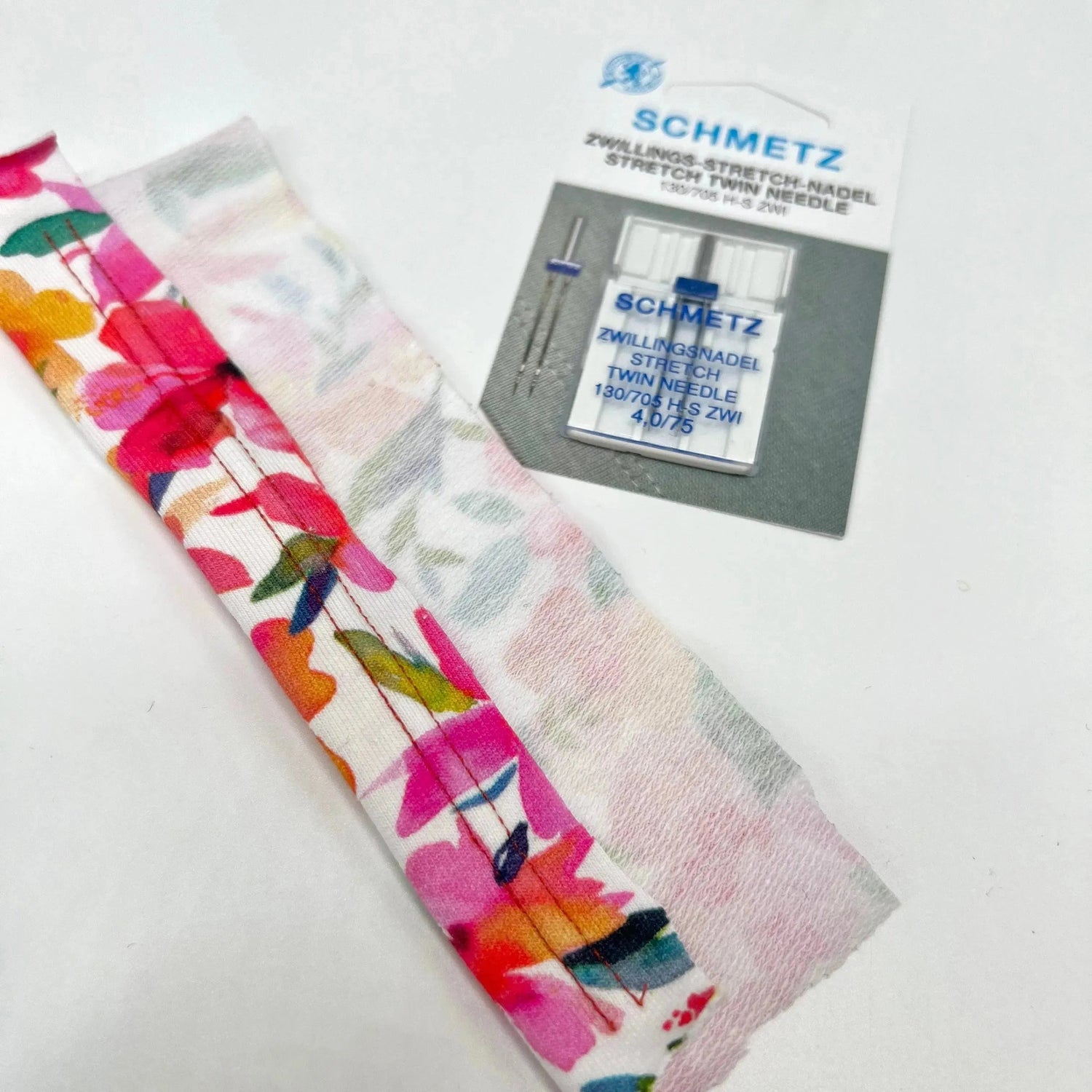
The double needle replaces your regular needle on your sewing machine. It consists of two identical needles joined by a bar between them and a single shank, as shown in the image below.

How to use a double needle?
The double needle is a tool often underestimated, yet extremely valuable in the world of sewing. It allows you to achieve a professional, beautiful, and neat finish easily, while maintaining the stretch of elastic fabrics. Whether you are passionate about sewing or simply curious to try something new, this article explains how to use a double-needle sewing machine, what it is for, and why you should definitely add it to your toolkit. If you are looking for a concrete example, an explanatory video is provided to accompany this tutorial and facilitate understanding.
What is a double needle used for?
If you have ever wondered what a double-needle sewing machine, also called a twin needle, is used for, you are in the right place. This small remarkable piece is actually a very useful item in many sewing projects, especially for working with stretchy fabrics like jersey or lycra.
The double needle consists of two identical needles fixed on a single bar with a single shank, making it compatible with most classic Juki sewing machines provided the model supports this option. It is simply installed in place of a universal needle and allows you to make two perfectly straight parallel lines in one pass.
It is ideal for preventing hems from puckering or seams from breaking, especially on stretchy fabrics. On the right side of the fabric, you get a neat, clean, and even finish; on the wrong side, the seam forms a zigzag stitch, which helps maintain the fabric’s suppleness and natural stretch. This finish is often used for t-shirt hems, sleeve edges, or sportswear.
However, it is important to properly place the upper thread spool, often doubled, and thread each thread through one of the needles. It is also important to adjust the tension on your machine to avoid any sewing issues or folds.
Another tip: by using two threads of different colors, you can play with contrasts and add a beautiful and decorative touch to your creations. This is a perfect option to customize a pattern and explore a different way of sewing.
If you have chosen a specific model of double needle, check the distance between the two needles (2 mm, 4 mm, etc.), as this will affect the final result. Some double needles are designed to sew only in straight lines, while others can tolerate slight zigzag movements – but be careful not to damage your machine’s plate.
Finally, to better understand its use, we recommend watching a tutorial video on the subject: nothing beats a visual explanation to master this technique well.
How to install a double needle?
To install a double-needle sewing machine, you need to follow a few simple but essential steps. Make sure you have your machine’s user manual at hand. Start by removing the single needle and place the double needle in the designated spot, making sure to orient the flat side of the shank towards the back. If you are using an electronic machine, the machine settings may require checking the stitch width to avoid breaking the needle. Be careful not to choose a decorative stitch that is too wide, as this could damage the second needle.
Next, install the two thread spools: the first spool on the main spool holder, and the second spool on an auxiliary holder or an additional spool holder (a tip is to use a bobbin placed in a cup). Pass each thread through the thread guide and the thread lifter lever, following the path indicated on your machine, then thread each needle using a needle threader or manually, depending on the size of the double eye needle. Finally, place the threads towards the back, under the presser foot, to avoid knots and ensure smooth sewing.
Step 1: Remove your regular needle and place your double-needle sewing machine needle by its shank.
Step 2: Place your first spool on your spool holder, pass your thread through the thread guide as indicated on your machine, not forgetting to pass it through the thread lifter lever.
Step 3: Do the same with your second spool.
If your spool is too large for the spool holder, place it in a cup as a support, or you can replace one of the two spools with a bobbin.
Step 4: Pass each thread through each needle as shown in the image below, then place them to the back so they do not get in the way when sewing.

And there you go, you can start sewing your fabrics! Here is the result you will get with the straight stitch.


Which fabrics to sew with a double needle?
The double needle is particularly suited to stretchy fabrics, such as jersey, knits, or stretch fabrics. It allows you to sew without distorting the fabric while preserving its elasticity, which is essential for hemming a t-shirt or a knit dress. It is also suitable for lightweight fabrics, such as cotton or double gauze, and can be used for bias finishes, decorative details, or flat seams on woven garments. If you want to knit in the round or simulate circular knitting, you can even combine it with knitting needles or double-pointed needles for hybrid projects.
Which stitches to make with a double needle?
With a double-needle sewing machine, you can make several types of stitches, mainly the straight stitch, zigzag stitch, decorative stitches, parallel topstitching, or even make a hem depending on the settings of your Juki sewing machine. The straight stitch is perfect for edge finishes, while the zigzag stitch adds a more elastic and flexible touch. This technique is ideal for sewing elastic hems, parallel topstitching, or even for customizing creations by topstitching patterns. You can also play with the size of the double needle depending on the desired effect: a small size for fine fabrics, a larger one for thicker fabrics.
Double needle vs single needle: what are the differences?
The difference between the double needle and the single needle is mainly functional. The single needle is versatile, but it does not allow for parallel topstitching. The double needle, on the other hand, offers a much more professional finish, a big time saver, and controlled elasticity on suitable fabrics. Its advantage is to allow elastic sewing, while keeping a clean and neat appearance on the right side. If you want to sew jersey or sew easily on stretch fabrics, it remains the tool to choose.
Double needle for what type of sewing?
The double needle is perfect for sewing hems on t-shirts, leggings, or sportswear. It is also used for decorative projects, for circular seams, or for invisible finishes on fitted garments.
It can even be used for neckline seams, pocket or sleeve seams, especially when you want a symmetrical and elegant finish. For those looking for a flexible solution, renting Juki sewing machines offers an excellent way to try this efficient equipment without commitment. Moreover, for fans of circular knitting, using a knitting needle alongside can allow for original round-knit projects.
Conclusion
Whether you are a beginner or an experienced sewer, learning to use a double-needle sewing machine is an essential step in your progress. This small tool, easy to install, will offer you great results, while opening the door to many creative possibilities. If you still have doubts or installation problems, do not hesitate to consult your machine manual, watch our explanatory video, or read other tips and feedback on our blog. You will see, once you get the hang of it, it is very handy!

Leave a comment
All comments are moderated before being published.
This site is protected by hCaptcha and the hCaptcha Privacy Policy and Terms of Service apply.