


























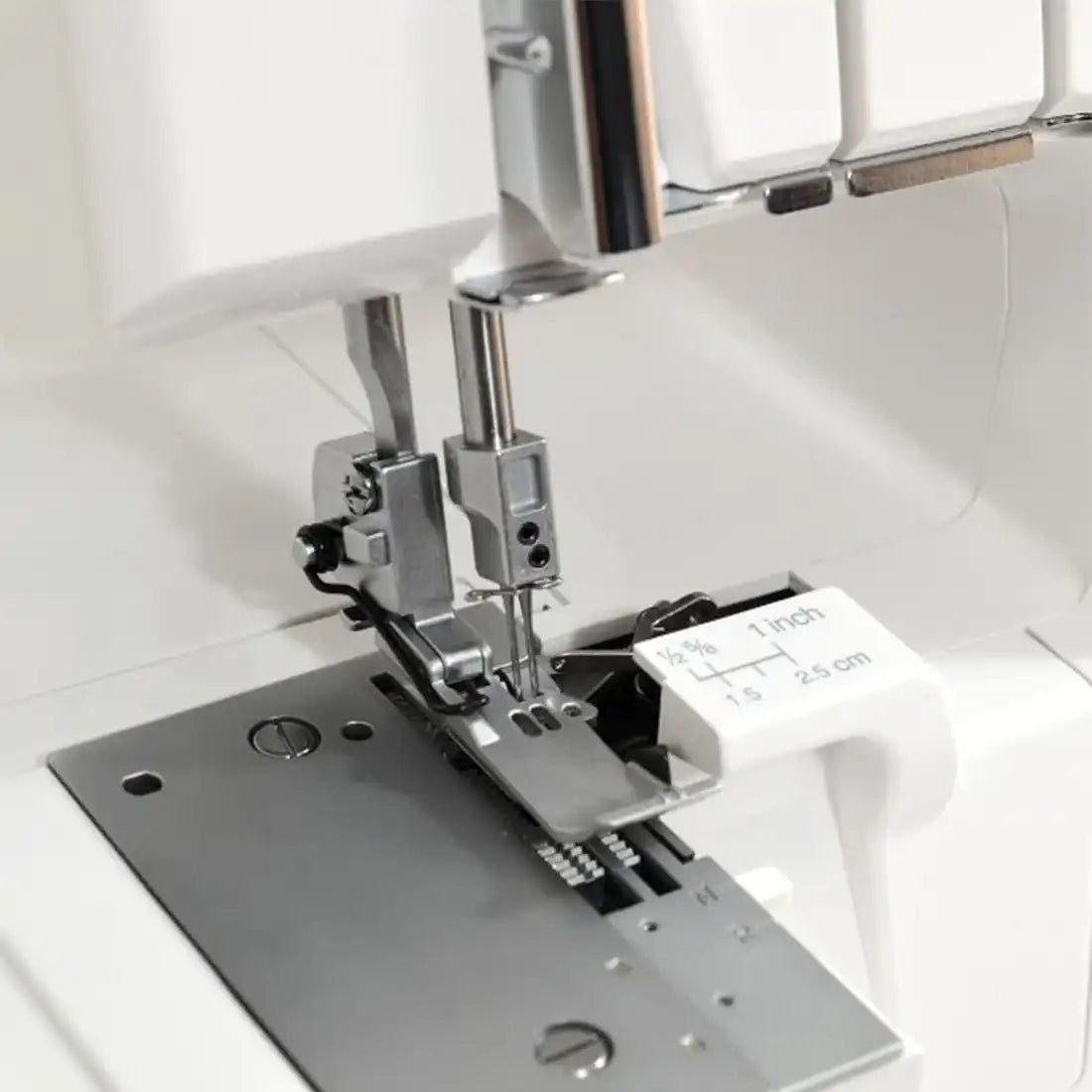
Table of contents:
If you ask yourself this question after replacing a broken serger needle for the third time in an hour, rest assured: you are not alone. Repeated needle breakage is one of the most frequent serger needle problems, and it almost always has a specific cause, often easy to fix.
In most cases, this issue comes from a wrong serger adjustment, a poor needle choice, or common small serger mistakes made unknowingly: too tight tension, unsuitable fabric, improperly installed needle, or lack of maintenance. Result: the needle undergoes excessive stress... and eventually breaks.
The goal of this article is clear: to help you understand why your serger needles break, quickly identify the cause in your case, and apply the right solutions. You will discover how to choose the serger needle that fits, avoid mistakes that cause breakage, and sew calmly, even on thick or delicate fabrics.
Why do the needles of my serger often break?
Before acting, you need to understand. A serger operates at high speed and imposes strong mechanical stress on the needle. At the slightest anomaly, breakage becomes likely.
Most frequent causes
- Incorrect serger adjustment
- Common serger mistakes (inappropriate actions)
- Poorly prepared or too thick fabric
- Needle already weakened
- Insufficient maintenance
Poor settings: tension, speed, and alignment
Settings are the first thing to check when wondering why my serger needles break. Excessive tension or too high speed creates direct mechanical stress on the needle.
Which settings cause needle breakage?
- Thread tension too high
- Excessive sewing speed
- Poor looper alignment
- Inappropriate presser foot pressure
Common mistakes that break serger needles
Even with good settings, certain habits explain why a serger needle breaks regularly. These mistakes are frequent and often unconscious.
Actions to absolutely avoid
- Pulling or pushing the fabric while sewing
- Forcing over thick layers
- Sewing with a slightly bent needle
- Changing direction without slowing down
These common serger mistakes are responsible for many breakages, even among experienced users.
Maintenance and mechanics: when the serger is the cause
If the problem persists despite good settings, the machine itself may be the cause. A poorly maintained serger loses precision and increases the risk of breakage.
When should you have your serger serviced?
- Unusual noises
- Breakage always in the same place
- Irregular stitches
- Lint buildup
According to recommendations from brands like Juki, Bernina, or Pfaff, periodic servicing is advised.
Summary table: causes and solutions
| Observed problem | Probable cause | Solution |
|---|---|---|
| Immediate breakage | Incorrect setting | Reduce tension |
| Breakage on thick fabric | Excessive speed | Slow down |
| Repeated breakage | Worn or unsuitable needle | Replace |
| Localized breakage | Mechanical problem | Maintenance |
Bonus for Why do my serger needles break?
Anticipation remains the best solution. Here is a list of points to check before starting to sew.
Pre-sewing checklist
- Check the needle condition
- Clean the machine
- Test on a scrap
- Adjust the speed
Conclusion
If you were wondering why my serger needles break, you now know that the answer almost always lies in the settings, technique, or maintenance. By correcting these points, you greatly reduce the risk of breakage and extend the life of your machine.
FAQ on Why do my serger needles break?
Why does my needle break mostly on thick fabrics?
Thick fabrics require a reduced speed and good preparation of bulky seams.
Is a universal needle sufficient for a serger?
No, some machines require specific needles. Always check the manual.
How often should serger needles be changed?
Can I continue sewing after a needle break?
No. You must always check for the absence of fragments to avoid damaging the machine.

Leave a comment
All comments are moderated before being published.
This site is protected by hCaptcha and the hCaptcha Privacy Policy and Terms of Service apply.