



















Table of Contents:
Bias tape is a key element in sewing, used to provide a clean and attractive finish the edges of a fabric. Whether for a garment or an accessory, it protects the fabric while adding an elegant touch.
In this article, we will detail the steps for making bias tape, the different application methods, and the techniques for achieving a perfect finish. .
How to make bias tape?
If you want bias tape that perfectly matches your fabric, the best option is to make it yourself . This allows you to adapt sits color, width, and flexibility according to your project.
Cutting bias tape strips


To obtain soft bias tape that is easy to apply, you need to cut the strips at a 45° angle to the selvedge of the fabric.
- Place a set square on the fabric selvedge and draw a first diagonal line.
- Draw a series of strips parallel to the first line drawn, at the desired width (generally 4 cm).
- Continue cutting several strips until you have the required length.
Cutting on the bias allows the fabric to better follow rounded shapes, because the bias is the part of the fabric that stretches the most. It is therefore easier to "shape".
Making bias tape with a bias tape maker

Once the strips have been cut, they must be folded in half to obtain bias tape ready to apply.
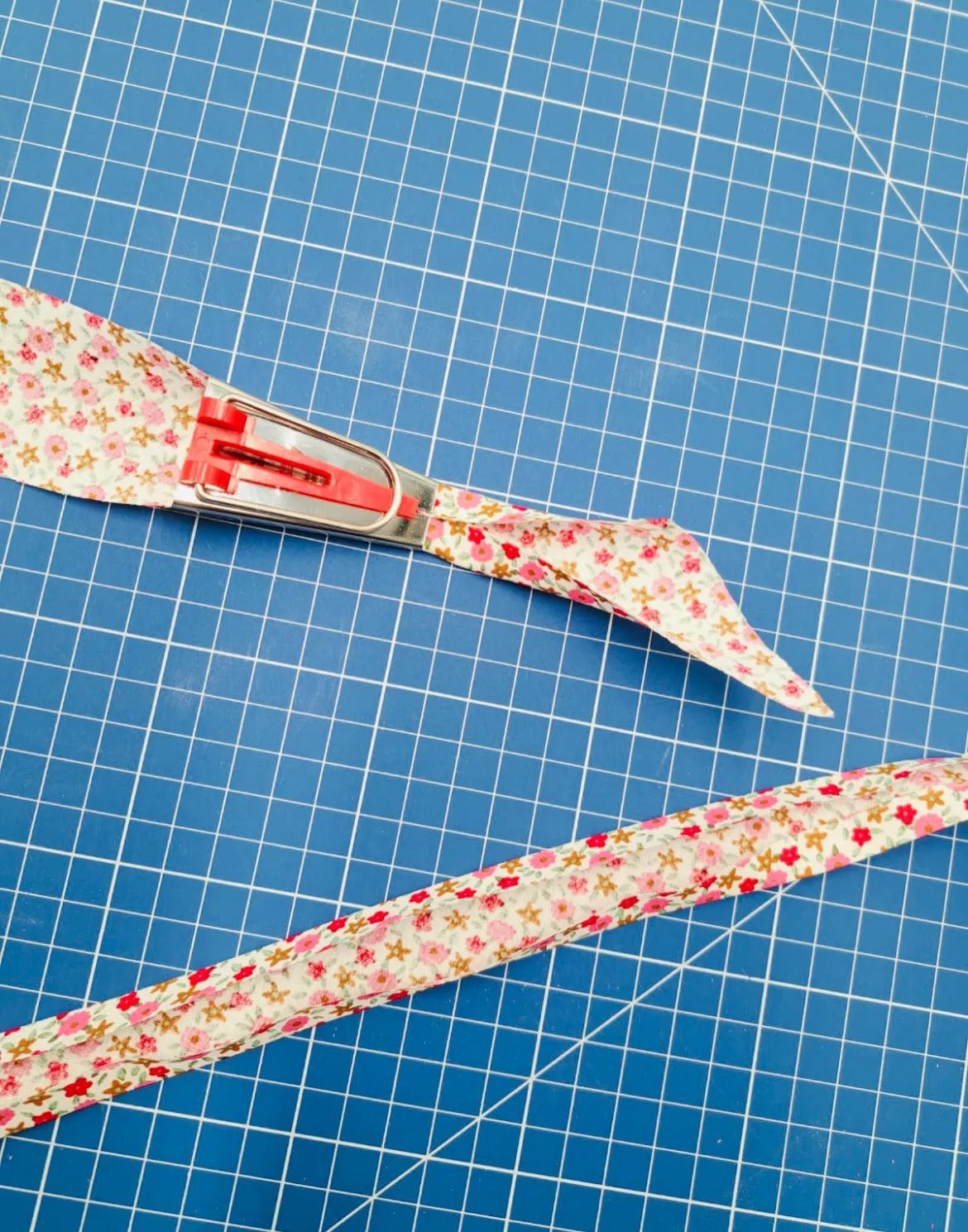
- Feed the fabric strip through a bias tape maker (or mouse).
- Slide it through slowly while pressing immediately to set the folds.
If you do not have a bias tape maker, you can mark the folds by hand with an iron.
Join bias tape strips to lengthen it.


If one strip is not sufficient for your project, you need to join several pieces of bias tape .
- Place the right sides of the strips together, forming a right angle (leave the corners extending).
- Draw a diagonally from the top-left corner to the bottom-right corner and stitch by machine.
- Open the seam, press and cut off the excess of fabric, leaving a 5 mm seam allowance (to avoid bulk).
How do you apply bias tape over an edge?
It consists of wrap the edge of the fabric with the bias tape to achieve a neat finish.
Secure the bias tape to the wrong side of the fabric


- Open out the bias tape and position it right side against the wrong side of the fabric , leaving extend 1 mm .
- Stitch in the fold of the bias tape along the edge of the fabric.
This first line of stitching allows you to hold the bias tape in place before folding it over.
Fold over and secure the bias tape on the right side

- Fold the bias tape over onto the right side covering the fabric edge and the previous stitching completely. If you have difficulty hiding the previous stitching, trim the seam allowances.
- Pin carefully and stitch 1 mm from the edge to secure it permanently.
To prevent puckering and ensure a secure hold, it is recommended to flatten the seam with your fingernail before stitching.
How to achieve a clean finish on the edge of bias binding?
Classic method: straight stitching and turning


For a clean finish:
- Fold the bias binding in half lengthwise and mark a guide line where it extends beyond the fabric.
- Sew across the width of the bias binding , starting from the fold made up to the first fold of the bias binding.
- Cut off the excess and turn with a sharp tool to form the corner properly.
This technique is ideal for clean, structured corners .
Trim out a corner to avoid bulk
If the fabric is thick, it may be necessary totrim out the corner to reduce the bulk:
- Remove some of the fabric from the center of the corner , without touching the seams.
- Fold the ends inside , then press to set the fold.
This technique is particularly useful for bias binding applied to thick fabrics such as denim or wool fabric.
How to apply bias binding to a curve?


On rounded edges applying the bias binding is more flexible .
- Pin the bias binding along the curve making it follow the shape of the fabric closely.
- Sew slowly while maintaining slight tension to prevent puckering.
- Turn it inside out and press carefully to secure the bias binding properly.
If the curve is very tight, it may be useful to make small snips (notches) in the seam allowance to allow the bias binding to adapt better.
How to sew flat bias binding?


Flat bias binding is a finish where only the wrong side is visible .
- Place the bias binding right sides together with the fabric and stitch in the fold.
- Turn the bias binding toward the inside so that it is visible only on the wrong side.
- Stitch 1 or 2 mm from the edge to secure it permanently.
This technique is ideal for hems and lining finishes .
Conclusion
Whether to reinforce a seam, structure a garment, or add an aesthetic touch, bias binding is an essential sewing technique .
Key point:
- Cut your bias binding at 45° for greater flexibility.
- Join several strips with a diagonal seam.
- Apply bias binding folded over the edge or flat depending on the desired effect.
- Adapt the stitching to curves for a smooth finish.
- Press after sewing for a neat and durable result.
A well-applied bias binding provides real added value to creations and guarantees a neat and professional finish.

Leave a comment
This site is protected by hCaptcha and the hCaptcha Privacy Policy and Terms of Service apply.