





Table of Contents:
How to choose your needle for your sewing machine?
Dive into the fascinating world of sewing machine needles with this comprehensive guide designed to help you choose the right needle according to the fabric, the project, and the desired result. Whether you are a beginner, an experienced sewer, or simply curious, understanding the function of needles for sewing machines is essential to achieve precise finishes and avoid any problems during sewing. Each type of fabric requires a suitable needle: it’s often a detail overlooked but crucial.
Contrary to what one might think, it’s not enough to use a “universal” needle for all your projects. The choice of sewing machine needles depends on two key criteria: the thickness and type of fabric. This helps you avoid many issues like a broken needle, skipped stitches, or damaged fabrics.
That’s why we have provided you with a clear summary table to know which needle to use depending on the fabric: silk, denim, jersey, fine cotton, organza, stretch fabric, thick fabric, etc. This table allows you to quickly identify the needle type, its number, and the corresponding color code, especially for brands like Schmetz, Bohin, or Singer. This visual aid is perfect to guide you in your choices, and you can even download it as a PDF to always have it on hand.
How to choose the needle for which fabric?
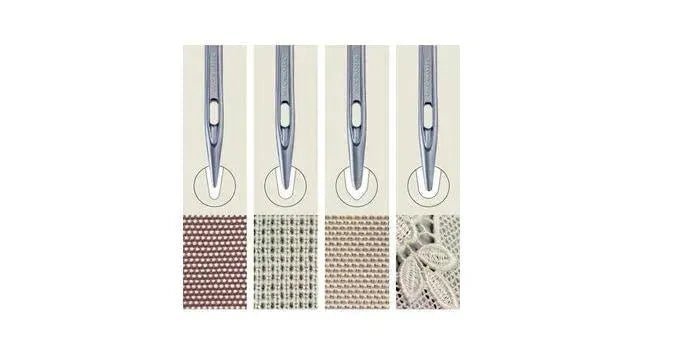
The needle size corresponds to the diameter of its shaft, expressed in hundredths of a millimeter (usually from 60 to 110). The thicker the fabric, the larger the needle size you should choose to prevent it from breaking. Conversely, for fine fabrics like silk or viscose, opt for a fine point to avoid damaging the fabric. For example, a microtex needle is ideal for very fine or delicate fabrics. For stretch fabrics, the stretch needle is recommended because it has a slightly rounded point that slides between the stitches.
Do you want to make a hem on a t-shirt? Choose double stretch sewing machine needles for a professional finish. Do you have a circular knitting project or hand sewing? Specific needles like knitting needles or double-pointed needles will be more suitable.
Which needle for a sewing machine?
The needles for sewing machines generally have a flat shank that easily fits under the presser foot. They are compatible with most domestic sewing machines, but be sure to check the system (for example 130/705 H for household machines). If you work with an industrial machine, there are also needles specific to this type of equipment.
Some universal needles are suitable for standard fabrics, but for optimal results, it’s better to choose a special needle according to your sewing project. For example, a jeans needle for denim fabrics, an embroidery needle for delicate threads, or a ballpoint needle for sewing knit fabrics.
How to assess fabric thickness?
The fabric thickness is a key factor in choosing the needle. You should never use a needle that is too fine on a thick fabric, as this can cause breakage or uneven stitches. Conversely, a needle that is too large on a lightweight fabric may leave visible holes. Our chart will help you quickly assess the fabric thickness and choose the sewing machine needle that best suits your project.
What tips are there for choosing your sewing needle?
Before starting a project, ask yourself the right questions: Which fabric will I use? What finish do I want to achieve? Is it a stretchy, thin, or heavy fabric? These factors guide the choice towards a universal needle, stretch, microtex, jeans, etc. Also remember to change needles regularly: a dull needle can damage the fabric, cause thread tension problems, or simply stop stitching properly. Whether you work with Juki machines or other brands, a new needle for each project is highly recommended. A new needle for each project is strongly advised!
How to avoid sewing problems?
Many problems such as skipped stitches, tangled threads, broken needles, often come from an unsuitable needle. Using a dull needle, an incorrect needle point type, or an inappropriate size can ruin your sewing. Follow our tips, consult our reference chart, and don’t hesitate to check the manual of your sewing machine to know the manufacturer’s recommendations.
Which needle brands do we recommend?
Among the most reliable and recognized brands, you will find the Schmetz brand, one of the best designed brands, available in our store. Each brand offers a variety of ranges suited to each fabric and each type of sewing. You can easily find the equivalent of the size Singer or Schmetz if you have any doubt thanks to our guide.
How to properly change and install the needle on the machine?
Changing a machine needle is a simple action but requires some precision. Don’t forget to turn off the machine, then loosen the screw holding the needle. Insert the new needle with its flat side facing backward, until it is fully inserted. Whether you use a Juki flatbed machine or another type of machine, check that it is straight and securely held before resuming your sewing. This step is part of best practices to ensure quality work and avoid accidents.
As you can see, choosing this item is not trivial. It affects the quality of your work, the longevity of your machine, and your pleasure in sewing. With our advice, our summary table, and our product guides, you are ready to work with all types of fabrics with confidence.

Summary table of needles to use for each fabric
Type of fabric |
Needle to use |
Point |
Size |
|---|---|---|---|
| Antibacterial |
Standard needle (universal) |
Normal | 60 to 85 |
| Calico |
Standard needle (universal) |
Normal | 60 to 100 |
| Canvas |
Standard needle (universal) |
Normal | 70 to 100 |
| Cotton |
Standard needle (universal) |
Normal | 60 to 85 |
| Swiss cotton liberty style |
Standard needle (universal) |
Normal | 60 to 85 |
| Lace | Individually adapted needle | 70 to 90 | |
| Double gauze | Jersey needle | Rounded | 65 to 90 |
| Terry cloth |
Standard needle (universal) |
Normal | 80 to 90 |
| French Terry | Jersey needle | Rounded | 80 to 90 |
| Faux fur |
Standard needle (universal) |
Rounded | 80 to 100 |
| Jeans |
Jeans needle (universal) |
Very fine | 85 to 100 |
| Jersey | Jersey needle | Rounded | 70 to 90 |
| Cotton jersey | Jersey needle | Rounded | 70 to 90 |
| Cotton jersey lined with minky | Jersey needle | Rounded | 70 to 90 |
| Jogging | Stretch needle | Medium ballpoint | 65 to 90 |
| Wool |
Standard needle (universal) |
Rounded | 70 to 100 |
| linen |
Standard needle (universal) |
Rounded | 65 to 85 |
| Linen viscose |
Standard needle (universal) |
Rounded | 65 to 85 |
| Lycra | Jersey needle | Rounded | 70 to 90 |
| Microfiber |
Standard needle (universal) |
Normal | 80 to 100 |
| Minky |
Standard needle (universal) |
Normal | 80 to 100 |
| Honeycomb | Stretch needle | Medium ballpoint | 65 to 85 |
| Dotted Swiss |
Standard needle (universal) |
Normal | 60 to 80 |
| Fleece |
Standard needle (universal) |
Rounded | 80 to 100 |
| Polyester |
Standard needle (universal) |
Rounded | 60 to 85 |
| Poplin |
Standard needle (universal) |
Normal | 60 to 85 |
| Satin |
Standard needle (universal) |
Normal | 60 to 100 |
| Faux leather |
Leather needle |
Triangular | 60 to 75 |
| Tartan |
Standard needle (universal) |
Rounded | 70 to 85 |
| Burlap |
Standard needle (universal) |
Normal | 60 to 80 |
| Tulle | Jersey needle | Rounded | 60 to 80 |
| Gingham |
Standard needle (universal) |
Normal | 60 to 85 |
| Viscose |
Standard needle (universal) |
Rounded | 70 to 80 |
| Voile | Standard needle (universal) | Rounded | 60 to 75 |
Sewing machine needles fit all machine brands, including Juki sewing machine models. You will find all our haberdashery available on our website. Happy sewing!

Leave a comment
This site is protected by hCaptcha and the hCaptcha Privacy Policy and Terms of Service apply.