












Table of Contents:
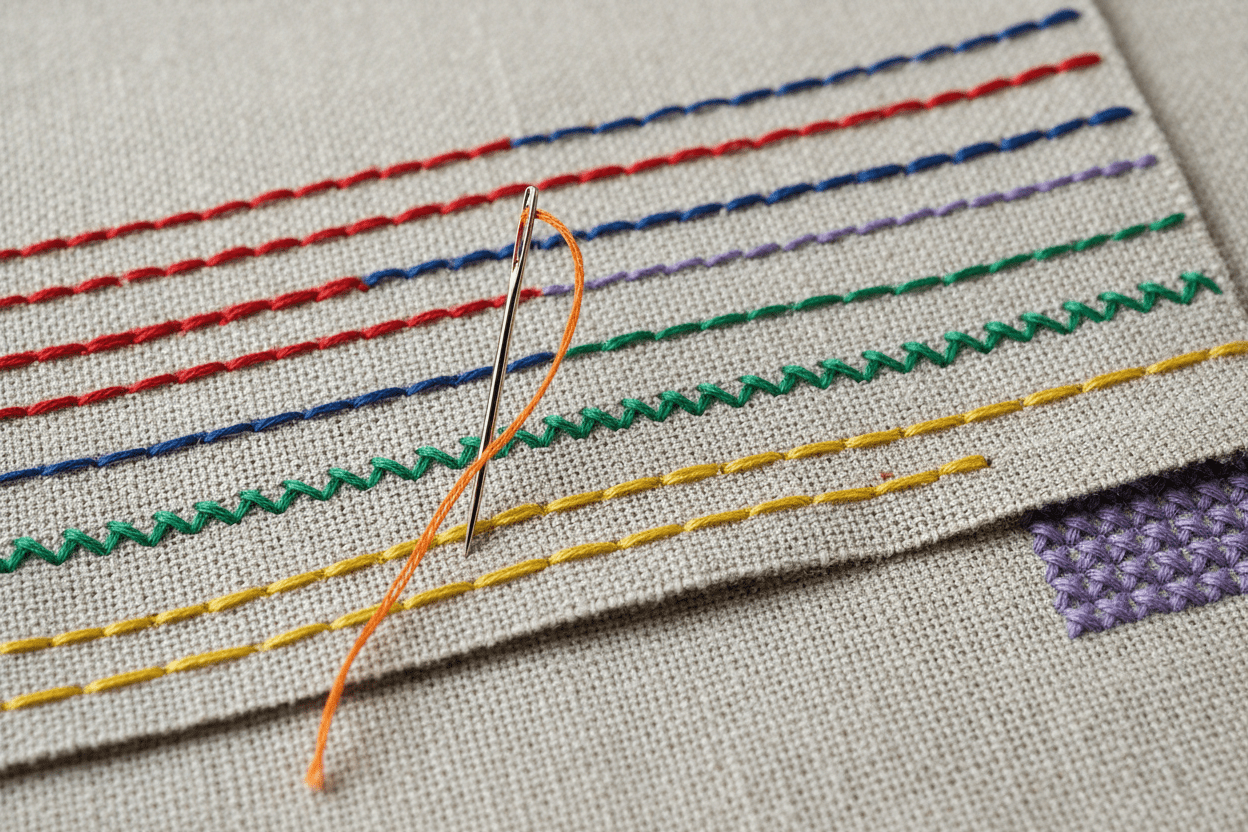
Hand sewing stitches are an essential foundation in sewing, whether you are a beginner or more experienced. Even with a high-performance sewing machine, like the models offered by Juki, hand sewing remains indispensable for many situations: precise finishing, quick alterations, hard-to-reach areas, or delicate work.
Mastering different hand sewing stitches not only improves the quality of your creations but also increases your independence in all textile projects. It is a key skill for achieving neat, strong, and attractive seams, whether on clothing, accessories, or household linens.
Each stitch has a specific function: some are used for durable assembly, others for temporary holding, or for invisible finishing. Choosing the right stitch and using suitable materials, like quality thread and a needle adapted to the fabric, results in a much more professional finish.
Why learn hand sewing stitches?
Learning hand sewing stitches has many advantages:
- allows sewing without a machine
- ideal for alterations
- essential for finishing
- offers more precision
These techniques are essential for progressing in sewing.
The most commonly used hand sewing stitches
There are several hand sewing stitches, each with a specific purpose: assembling, repairing, holding, or decorating.
The running stitch
What is it for?

The running stitch is the simplest stitch. It allows for quick seams but is not very strong.
Use it for:
- simple seams
- gathers
- you practice
- quick repairs
How to make a running stitch by hand?
- Work from right to left;
- Insert your needle at the start of the seam; Pull it out a few millimeters further on;
- Alternate the stitches;
- Continue regularly;
- Finish with a backstitch.
Tip: keep stitches even for a neat finish.
The backstitch
What is it for?

The backstitch is very strong. It replaces a machine seam.
Use it for:
- join fabrics
- repair a garment
- make strong seams
How to make a backstitch?
- Sew the first stitch;
- Bring the needle out further away;
- Go back to the previous stitch;
- Bring the needle out again further away;
- Repeat the movement;
- Finish with a backstitch.
Tip: the shorter the stitches, the stronger the seam.
The basting stitch
What is it for?

The basting stitch is a temporary stitch.
Use it for:
- hold fabrics together
- prepare a seam
- adjust a garment for fitting
How to make a basting stitch?
- Make long stitches;
- Do not tighten the thread;
- Work quickly;
- Remove the thread after sewing.
Tip: use a contrasting thread.
The invisible stitch
What is it for?
The invisible stitch allows discreet finishes.

Use it for:
- hems
- cushions
- closures
How to make an invisible stitch?
- Sew into one edge;
- Pass through the other edge;
- Take a small amount of fabric;
- Alternate sides;
- Tighten slightly.
Tip: use a thread of the same color.
The blanket stitch
What is it for?

The blanket stitch strengthens edges and decorates.
Use it for:
- edges
- appliqués
How to make a blanket stitch?
- Work on the edge;
- Make vertical stitches;
- Pass the thread under the needle;
- Tighten slightly.
Tip: perfect for felt.
The overlock stitch
What is it for?

The overlock stitch prevents the fabric from fraying.
Use it for:
- finishes
- delicate fabrics
How to make an overlock stitch?
- Work on the edge;
- Sew diagonally;
- Outline the fabric;
- Repeat regularly.
Tip: space the stitches slightly.
Table: hand sewing stitches and uses
| Stitch | Usage |
|---|---|
| Running stitch | simple seam |
| Backstitch | strong seam |
| Invisible stitch | finish |
| Basting stitch | temporary |
| Blanket stitch | suit edge |
Essential equipment
To sew by hand, little equipment is needed:
- a suitable needle
- sewing thread
- a thimble
- scissors
Using quality thread, like those offered in haberdashery such as Verotex, results in stronger and more even stitches.
Mistakes to avoid
Here are the common mistakes:
- sewing without preparation
- using a thread that is too long
- not marking the reference points
- pulling the thread too hard
- do not use a thimble
Tip: marking lines with chalk improves accuracy.
Conclusion
Mastering hand sewing stitches is essential for successful sewing projects. These techniques allow you to make strong seams, clean finishes, and effective repairs, even without a machine.
Each stitch has its use: the running stitch for beginners, the backstitch for strength, and the invisible stitch for discreet finishes. Using them at the right time quickly improves the quality of your creations.
With a little practice, your movements will become more precise and your stitches more even. Taking the time to practice will help you gain confidence and succeed in all your sewing projects.
FAQ about hand sewing stitches
What is the simplest stitch?
The running stitch is ideal for beginners.
Which stitch is the most durable?
The backstitch is the strongest.
Which stitch for an invisible finish?
The invisible stitch is recommended.
Can you sew everything by hand?
Yes, with practice.

Leave a comment
This site is protected by hCaptcha and the hCaptcha Privacy Policy and Terms of Service apply.