










Table of Contents:
Choosing the ideal Sewing machine can seem complex between mechanical or electronic models, technical features, and varied budgets. We help you see clearly, whether you are a beginner seeking simplicity or a passionate user of stretch clothing, upholstery, or patchwork requiring a free arm.
Discover how your level, projects, and budget guide you to the ideal machine, while avoiding unnecessarily over-equipped models. Learn to spot reliable brands, essential accessories, and the keys to a confident purchase in specialized stores or online.
Before choosing your Sewing machine: the 3 key questions
Choosing a Sewing machine that fits depends on your level, your projects (clothing, decorations, patchwork), and your budget. These criteria prevent purchase mistakes and ensure satisfying use.
Assess your level: are you a beginner, intermediate, or expert?
Beginners should choose a simple machine, with basic stitches (straight, zigzag) and easy handling. The Husqvarna H Class E20 is a reliable model for learning without frustration.
Intermediate users will appreciate features like automatic buttonholes or advanced settings. The JUKI HZL-353 ZR is perfect for projects like bags or upholstery.
Professionals need power. Machines like the Juki TL-2200 QVP mini offer speeds up to 1500 stitches/minute and a 70-90 W motor, ideal for thick fabrics.

Define your sewing projects: clothing, decoration, patchwork?
For clothing, a machine with stretch stitches is essential for stretch fabrics. The Lewenstein Couture 190 ensures neat finishes.
Thick fabrics (jeans, faux leather) require a powerful motor (70-90 W) and a dual-feed foot. The JUKI HZL-60H combines strength and stability for these materials.
Patchwork requires a large space to the right of the needle (at least 25 cm). The JUKI HZL-DX3 adapts to complex projects.
Set your budget: how much does a good Sewing machine cost?
Entry-level machines (under €300), like the Lewenstein Lilly, are suitable for starting with essential stitches at a low cost but lack durability.
Mid-range (€300-700), like the JUKI HZL-353 ZR, combines quality and versatility for regular use.
High-end (over €700), like the Juki TL-2200 QVP mini, is aimed at enthusiasts or professionals, with advanced features for demanding projects.
Mechanical or electronic sewing machine: how to decide?
Are you unsure whether to choose a mechanical or electronic sewing machine and wondering how to pick the right sewing machine for your needs? Each model has distinct strengths: mechanical machines appeal for their durability and simplicity, while electronic ones offer more comfort, precision, and versatility. Let’s discover together which best suits your sewing profile.
The mechanical sewing machine: a reliable choice for durability and simplicity
Mechanical machines operate via dials to select stitches and adjust settings. They generally offer between 10 and 30 stitches, mainly straight and zigzag stitches, with a manual multi-step buttonhole.
Advantages: Their ease of use is ideal for beginners. Durability is a major asset: fewer electronic components reduce the risk of breakdowns. They are also more affordable, with models like the JUKI HZL-353 ZR.
Disadvantages: The limited number of stitches and the lack of automatic adjustments (tension, length) can frustrate advanced users. Features like automatic threading are rare, except on some high-end models.
The electronic sewing machine: comfort, precision, and versatility
Electronic machines feature an LCD screen to select stitches and adjust settings. They offer between 50 and over 200 stitches, including decorative and technical options.
Advantages: The ease of use is optimal with automatic threading, automatic backstitch, and one-step buttonhole, making it a sewing machine easy to use even for beginners. Precision is enhanced thanks to electronic settings, useful for thick fabrics like denim.
Drawbacks: Their price is higher, ranging from €400 to €1,500 depending on the model. The complexity of electronics can discourage beginners, and repairs are more expensive in case of breakdown.
|
Criterion |
Mechanical sewing machine |
Electronic sewing machine |
|
Handling |
Intuitive and direct (dials) |
Screen-guided, requires brief learning |
|
Number of stitches |
Limited (10 to 30 on average) |
Wide (50 to over 200) |
|
Settings (length/width) |
Manual, less precise |
Electronic, very precise |
|
Comfort functions |
Rare or nonexistent |
Many (needle threader, thread cutter, etc.) |
|
Buttonhole |
Manual in 4 steps or semi-auto |
Automatic in 1 step |
|
Ideal for... |
Beginners, occasional use, small budgets |
Regular sewists, varied projects, seeking comfort |
|
Durability / Maintenance |
Known for being very robust, simple maintenance |
Robust but more sensitive, professional servicing recommended |
Technical features explained for a good choice
Wondering how to choose a sewing machine among the many models available? To make the right choice, it’s essential to understand the technical features that make a difference: stitch types, practical automations like the needle threader, essential settings, and motor power. Here’s a clear breakdown to select a machine perfectly suited to your sewing needs.
Sewing stitches: essentials and comfort options
The straight stitch (for assembly) and zigzag (for finishing) cover 90% of needs. The stretch stitch is essential for elastic fabrics like jersey or lycra, preventing breaks when stretched.
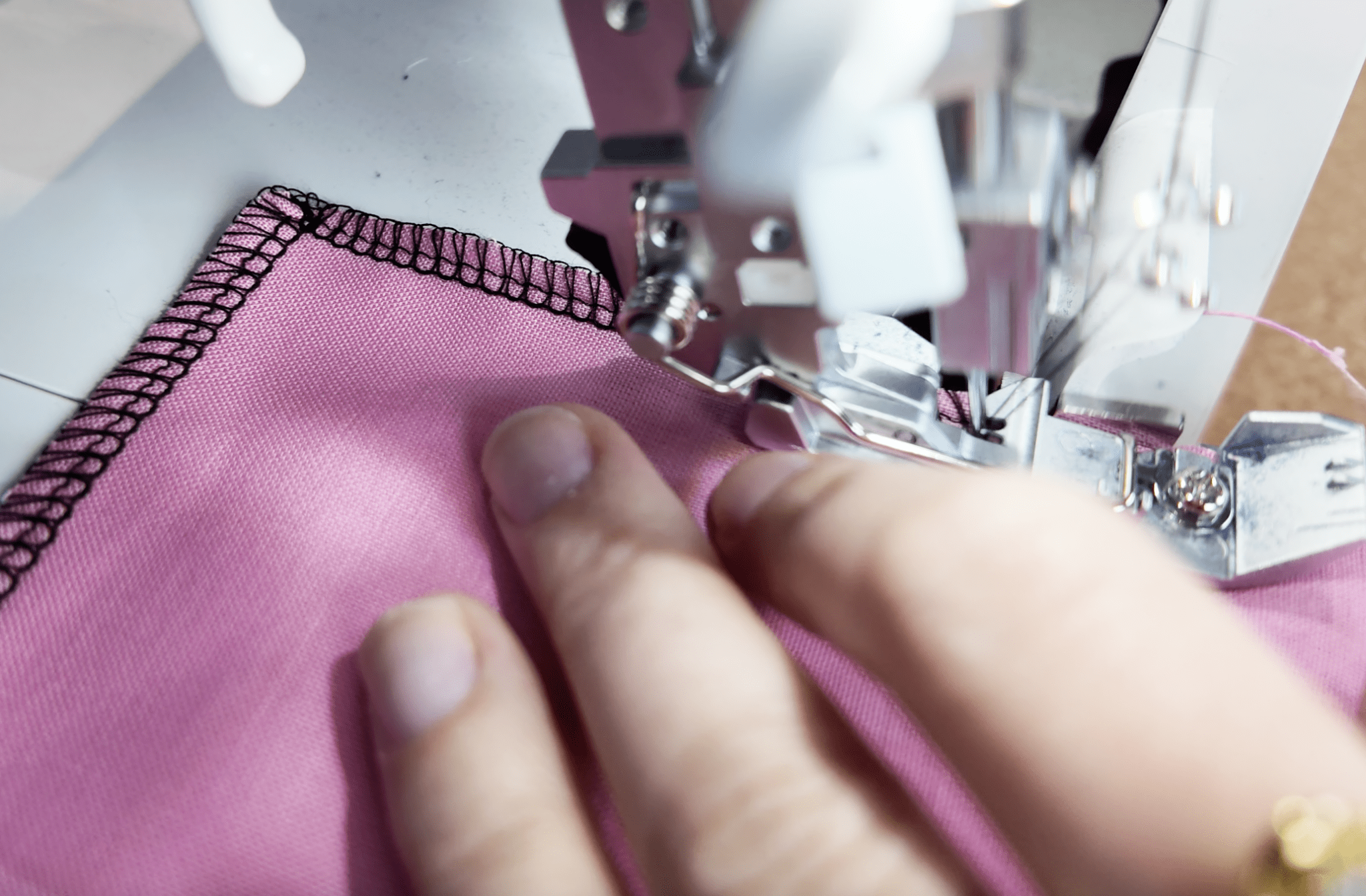
The overlock stitch, often underestimated, cleans edges without fraying. It’s ideal for delicate fabrics. The one-step automatic buttonhole guarantees uniform results, saving time for all skill levels, especially for garments requiring multiple buttons.
For advanced projects, the triple zigzag strengthens seams on sportswear. The discreet stretch straight stitch is suitable for fitted creations where the finish must remain invisible. Technical fabrics like faux leather require specific stitches to avoid perforation marks.
Automation that makes life easier: needle threader, speed control
The automatic needle threader simplifies daily use, especially for beginners or people sensitive to eye strain. The speed control allows optimal handling of curves or thicknesses, useful for upholstery. The automatic backstitch and built-in thread cutter ensure clean finishes without manual adjustments. It’s an asset for long projects like patchworks.
Electronic models offer extra features: memory for custom settings, gradual start for beginners, or preset modes by fabric type. These options reduce the learning curve for intermediate users aiming to improve efficiency.
Essential settings: length, width, and presser foot pressure
Adjusting stitch length (4-6 mm for gathers, 2-3 mm for structural seams) and zigzag width (narrow for fine fabrics, wide for thick ones) is essential. The presser foot pressure, available on mid/high-end models, adapts the machine to fabrics that are very fine (silk) or thick (denim). Too much pressure on a light fabric causes puckering, while too little pressure on a thick fabric leads to uneven feeding.
This setting is adjusted manually via a graduated dial on mechanical machines, or electronically on high-end models. Hybrid systems combine precision and ease of use. They suit versatile sewers.
Motor power and feed system: the secret to sewing all fabrics
For thick fabrics (jeans, leather), opt for a machine costing at least €500. Models like the Juki HZL-F370 handle thicknesses thanks to their powerful motor and dual feed. PFAFF’s IDT system, feeding fabric from both top and bottom, prevents distortion on difficult fabrics (silk, jersey) and ensures aligned patterns. This system is especially useful for patchwork or technical garments requiring precision.
Industrial sewing machines like the Juki TL-2200 qvp mini even sew extreme materials like leather or thick layers. For mixed use (hobby and occasional projects), mid-range home machines offer a good balance between power and size.
Features include:
- A standard presser foot (assembly and zigzag)
- A zipper foot (precision on openings)
- A buttonhole foot (uniform finishes)
- Spare bobbins (prevents thread breaks)
- A needle set (adapted to the fabric, flat needle for leather)
- A seam ripper (quick error correction)
- A protective cover (protection against dust)
- A detailed manual (guide for precise settings)
- A cleaning tool (maintenance for extended lifespan)
At Verotex, discover our selection of Juki sewing machines, Lewenstein, and more. Start sewing today!

The inseparable duo: how to choose the right needle and thread?
Many beginners wonder how to choose a sewing machine, but another essential aspect is often overlooked: the needle and thread. These two elements form an inseparable duo to ensure strong and neat seams. Needle size, type, and thread quality directly influence the final result. Let’s discover together how to select them well to get the most out of your machine.
The art of choosing the right needle: size and type
Changing your needle every 8 to 10 hours of sewing prevents quality issues like uneven stitches, broken threads, or metallic noises. A worn needle damages the fabric and the machine. For thick fabrics like jeans, replace it even after 5 to 6 hours of use.
Sizes range from 60 to 110. For fine fabrics (silk, voile), choose a 60/8 or 70/10 needle. Medium fabrics (cotton, poplin) require an 80/12 or 90/14 needle. Thick fabrics (jeans, faux leather) need sizes 100/16 or 110/18. This gradation ensures precise piercing without damaging the fabric.
Needle types:
- Universal: Suitable for classic fabrics like cotton or polyester. Ideal for everyday projects (covers, tablecloths).
- Jersey/Stretch: Rounded tip for stretch fabrics. Prevents piercing the knit. Essential for sportswear or leggings.
- Jean: Reinforced shaft for dense fabrics like denim. Withstands repeated friction on thick layers.
- Microtex: Extremely fine for silks or delicate fabrics. A 60/8 needle is perfect for cotton voile.
- Leather: Sharp point to pierce without tearing. Essential for repairing leather jackets.
Sewing thread: quality above all
A low-quality thread breaks easily and clogs the machine. Polyester is the most versatile and resistant to friction. For 100% cotton fabrics, a cotton thread ensures even wear. Demanding projects (bags, jeans) require an extra-strong thread.
Match each fabric with the right needle-thread combination:
- Project in Cotton / Poplin: Universal Needle 80/12 + Polyester or cotton thread. Polyester adds strength to invisible seams.
- Project in Jersey / Stretch Fabric: Stretch Needle 75/11 + Quality polyester thread. The pair reduces skipped stitches on stretch fabrics.
- Project in Jean / Denim: Jean Needle 90/14 or 100/16 + Durable polyester thread. The combination resists creases and abrasion.
- Project in Voile / Silk: Microtex Needle 60/8 or 70/10 + Fine polyester thread. Ideal for lace and delicate embroidery.
- Project in Faux Leather / Heavy Canvas: Leather or Jean Needle 100/16 + Extra-strong polyester thread. Strength is crucial for bags or belts.
The choice of needles and threads also depends on the machine. Flat-shank needles suit domestic machines, while industrial models require round-shank versions. Finally, a color code (e.g., Schmetz) simplifies identification: the top color indicates the type, the bottom color the size.
Finding your way through the jungle of brands and retailers
Asking how to choose a sewing machine also means navigating the many brands and retailers. Should you favor a new or used machine? Which manufacturers are reliable, and where to buy for the best service? Here’s how to navigate this jungle to make an informed choice suited to your sewing needs.
Trusted brands: who are the market players?
Lewenstein offers a good quality-price ratio, with models like the Lewenstein Couture 120 (120 stitch patterns, LCD screen) suitable for beginners and intermediates.
For enthusiasts, Juki dominates the high-end market. The JUKI HZL-DX5 (forward/reverse function with the pedal, automatic threading and thread cutting) is a must for quilting, despite its high cost. Note: some refurbished models may have parts from different sources. Prefer brands that control their manufacturing.
New or used sewing machine: advantages and disadvantages
A new sewing machine guarantees a like-new condition, full warranty, and the latest features (e.g., touchscreen). On the other hand, buying used allows you to get a high-end device at a lower cost but comes with risks: hidden wear, no warranty. Machines refurbished by professionals offer a quality-price balance.
For beginners, secondhand remains economical, provided the condition is checked (fabric tests, mechanisms). The used market offers varied options, but availability is often limited. Avoid purchases without thorough inspection.
Where to buy your machine: specialized dealer or big-box store?
Specialists offer personalized advice and demonstrations. Their local after-sales service and beginner classes ensure a smooth experience, ideal for advanced projects. On the other hand, big-box stores attract with low prices and sales, but after-sales service is more distant.
Online, reliability depends on the seller. For an informed purchase, combine the proximity of a pro with price comparison, especially for expensive models.

Maintaining your machine: steps to make it last for years
Knowing how to choose a Sewing machine is not enough: to make it last for years, proper maintenance is essential. Regular cleaning prevents most breakdowns, while oiling and professional servicing ensure optimal performance. Discover the simple and essential steps to preserve your machine and fully enjoy your sewing projects in the long run.
Regular cleaning to avoid 90% of breakdowns
Did you know that dust and thread residue cause most problems? These elements build up in the mechanisms and disrupt operation. Regular cleaning, even quick, prevents 90% of breakdowns. It’s a simple but crucial step for a high-performing machine.
To start, always unplug the machine. Remove the needle, presser foot, bobbin, and needle plate. Use the provided brush to remove dirt from accessible areas. Avoid blowing, as this pushes dust deeper. A can of compressed air is ideal for reaching sensitive corners.
Master your new machine! Sign up for our upcoming sewing classes.
Oiling and professional servicing: when and why?
Warning: some modern machines are self-lubricating! Be sure to consult your user manual before adding oil. For others, apply a drop of special oil on the metal friction points, avoiding plastic parts. Excess oil stains fabrics.
A professional service every 2 to 3 years is quality assurance. Like a car, it’s a reassuring investment. Technicians check mechanism alignment, replace worn parts, and optimize settings. This prevents costly repairs and extends the machine’s life.
For your sewing machine to work well, you must:
- Change the needle after each major project or every 8 hours of sewing.
- Dust off the bobbin area and feed dogs regularly.
- Use the protective cover to shield it from dust between uses.
- Always refer to your instruction manual for model-specific details.
By combining these actions, you maximize your machine’s reliability. A well-maintained machine remains a silent and efficient ally, ready to tackle every creative challenge without mechanical tantrums.
Ready to sew? The summary to make the right choice
Looking for your sewing machine is a personal process: yours exists. Ask yourself the right questions to avoid disappointments.
Start with an assessment: what is your level, your projects, your budget? A tight budget points to a sturdy mechanical machine, creative use justifies an electronic one. A beginner making simple clothes does not have the same needs as a professional working with thick leathers.
Mechanical machines remain essential for their simplicity and power. They appeal with their longevity and moderate price. Conversely, electronic machines attract with their convenience: automatic settings, one-click buttonholes, intuitive threading. This type of machine is ideal to reduce physical effort or explore decorative stitches.
Prioritize essential features. Need to sew denim? Choose a powerful motor and a dual-feed foot. Patchwork? Opt for a large workspace and a high presser foot lift. Details like needle stop up/down or a knee lifter make handling easier.
Choose a specialized retailer like Verotex who guides you, offers tests, and guarantees reliable after-sales service. In-store advice remains an asset, especially at the start.
Armed, you are ready to sew without frustration. The right sewing machine matches your aspirations. Happy sewing!

Leave a comment
This site is protected by hCaptcha and the hCaptcha Privacy Policy and Terms of Service apply.