





































Table of Contents:
Abnormal noise from the serger: when a machine that had previously run smoothly starts clacking, squeaking, or producing a metallic noise from the serger, concern is understandable. A noisy serger immediately draws attention, as the sound is often the first sign that an adjustment, maintenance issue, or mechanical component is causing a problem. In most cases, this abnormal noise from the serger does not signal a serious breakdown, but it should never be ignored.
Users mainly want to understand whether the noise is normal, whether they can continue sewing safely, and which actions are truly safe. Maintaining or disassembling a serger without the necessary knowledge can make the situation worse.
The aim of this article is to help you accurately identify an abnormal noise from the serger, recognize the different types of noise, understand their causes, and know when to act yourself... and, above all, when to call in a professional.
Abnormal noise from the serger: is it serious?
A change in noise does not always mean an immediate breakdown. Some sound variations are normal depending on the fabric, speed, or type of sewing, but others should raise concern.
The challenge is to distinguish an acceptable noise from an abnormal noise from the serger that requires a prompt inspection.
Key points to observe
- Usual noise vs. new noise
- Sudden or gradual onset
- Constant or intermittent noise
- Impact on stitch quality
A new noise, even a slight one, should always be taken seriously before continuing a project.
What types of noise can a serger make?
Identifying the exact nature of the noise is a key step. Each sound generally corresponds to a specific cause.
Recognizing the type of abnormal noise from the serger helps guide the diagnosis quickly.
Metallic noise or clacking: what does it mean?
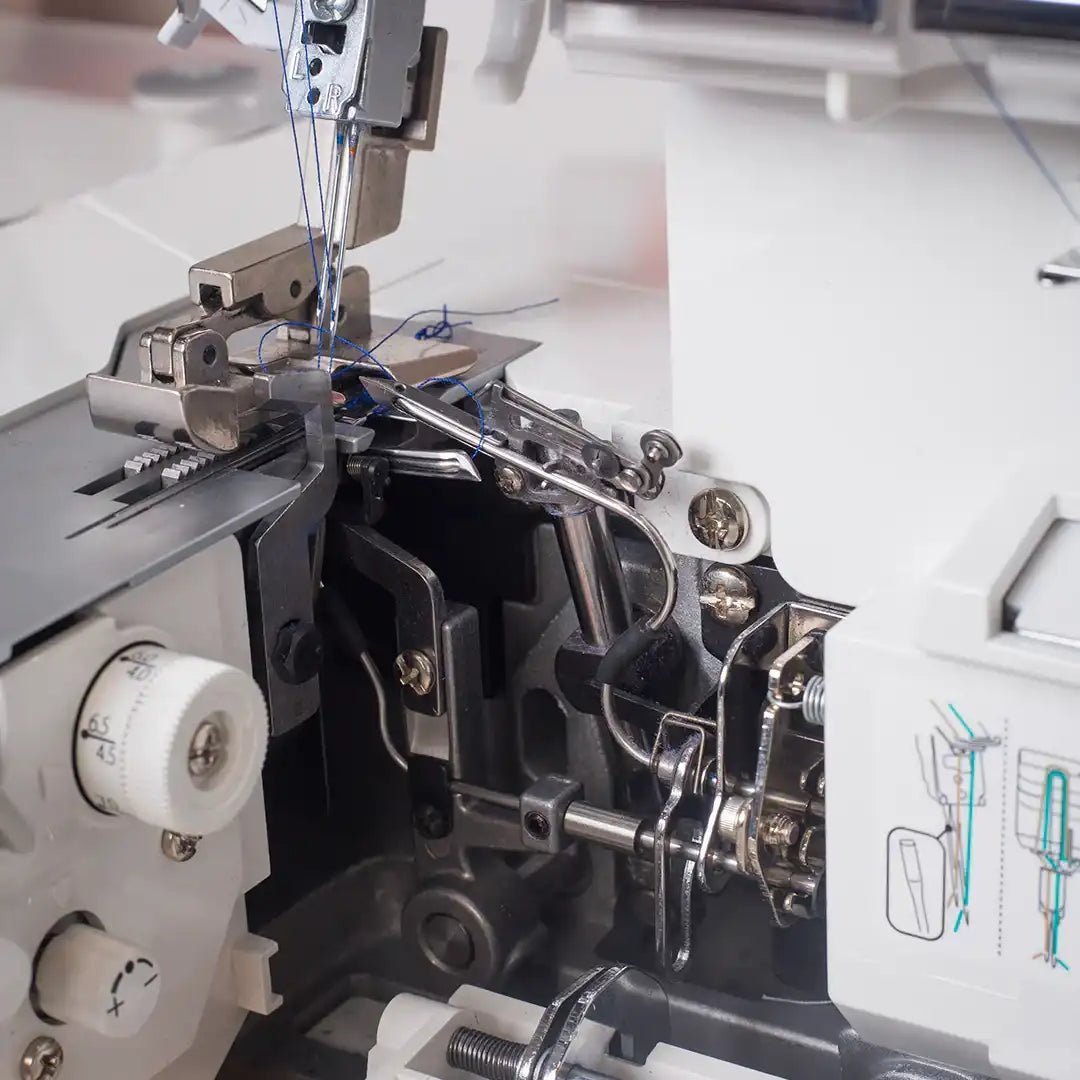
A serger clacking or a metallic noise often indicates abnormal contact between internal parts.
- Collision between needle and looper
- Loose screw or part
- Mispositioned component
This type of noise requires immediately stopping the machine to prevent wear or breakage
Continuous squeaking or rubbing
A regular squeaking or rubbing sound is often related to a lack of smoothness in the internal movements.
- Lack of suitable lubrication
- Accumulation of dust and lint
- Progressive component wear
An abnormal noise from the serger of this kind can quickly worsen if the machine continues to operate.
Mechanical causes of abnormal noise from the serger
When the noise persists despite correct settings, it may be a mechanical problem with the serger. A serger is a precision machine: its internal parts are adjusted to within a tenth of a millimeter.
Poor alignment is enough to cause an abnormal noise from the serger.
Common mechanical causes
- Loose internal part
- Looper misalignment
- Worn component
- Damaged or unsuitable needle
For more information, manufacturers such as Juki or Bernina recommend having mechanical noises diagnosed by our authorized repairer.
Settings and maintenance: common causes of noise
Incorrect settings or improper maintenance explain many cases of a noisy serger. However, it is essential to distinguish what can be checked safely from what should be entrusted to a specialist.
An abnormal noise from the serger is often the result of excessive strain.
Incorrect settings that make the serger noisy
Certain settings unnecessarily increase mechanical stress.
- Thread tension too high
- Excessive sewing speed
- Improper presser foot pressure
These adjustments can be made carefully, strictly following the manufacturer's manual.
⚠️ Maintenance: what not to do yourself
It is tempting to take apart your machine when it makes a noise, but this involves significant risks.
- Disassembly of the internal mechanism
- Improper lubrication
- Looper adjustment
- Work without suitable tools
Brands such as Bernina, Pfaff, and Juki clearly recommend entrusting internal mechanical maintenance to a professional. A qualified repair technician will preserve the machine’s precision, warranty, and longevity.
Summary table: noise, cause and solution
This table helps quickly identify the likely cause of an abnormal noise in the overlocker and the appropriate action.
| Type of noise | Likely cause | Recommended action |
|---|---|---|
| Sharp clicking | Loose part | Stop + professional inspection |
| Metallic noise | Needle / looper | Professional diagnosis |
| Squeaking | Lack of smooth operation | Servicing |
| Continuous friction | Internal buildup | Professional cleaning |
Bonus for Abnormal Noise in the Overlocker
Prevention remains the best protection against unusual noises. Appropriate use greatly limits the risks.
Preventive best practices
- Clean only accessible areas
- Respect the recommended speeds
- Use suitable needles
- Have the machine serviced regularly
Conclusion
An abnormal noise in the overlocker is a warning sign that should never be ignored. In most cases, it is a setting that needs correcting or maintenance that is due, but working on the internal mechanics yourself can make the problem worse.
Calling on a qualified professional helps preserve the machine’s precision, avoid costly repairs, and extend the overlocker’s lifespan. A machine properly maintained by a specialist remains reliable, quiet, and pleasant to use.
FAQ about Abnormal Noise in the Overlocker
Does an overlocker always make noise?
Yes, but the noise must remain regular and stable. Any unusual change must be checked.
Can I continue sewing with an abnormal noise?
It is strongly recommended not to continue without identifying the cause.
Can I maintain my overlocker myself?
Surface cleaning only. Any mechanical work must be entrusted to a professional.
When should I consult a repair technician?
As soon as the noise persists after simple checks or worsens.

Leave a comment
This site is protected by hCaptcha and the hCaptcha Privacy Policy and Terms of Service apply.