




















Table of Contents:
Why do my serger threads break? This question comes up very often among serger users, whether beginners or experienced. A serger thread that breaks interrupts work, creates uneven stitches, and can quickly become frustrating. Yet, in most cases, this serger thread problem is neither serious nor irreversible.
When looking for why my serger threads break, you want a quick, reliable answer that you can apply immediately. Breakage is almost always linked to incorrect serger thread tension setting, incorrect threading, common serger mistakes, or thread poorly suited to the machine’s speed and specific demands.
The goal of this article is to help you clearly understand why your serger threads break, identify the exact cause in your case, and apply simple and effective solutions to restore smooth and even sewing.
Why do the threads on my serger break so often?
Before diving into precise settings, it’s important to understand why thread breakage is more common on a serger than on a regular sewing machine. The serger operates at high speed and applies constant tension on several threads at once.
A serger thread that breaks is almost always a symptom of an imbalance between the machine, the thread, and the fabric.
Most frequent causes
- Incorrect serger thread tension setting
- Incorrect or incomplete threading
- Thread unsuitable for the serger
- Common serger mistakes during sewing
- Lack of maintenance on the serger
Identifying the main cause helps avoid changing all settings unnecessarily and solves the problem faster.
Incorrect tension setting: the number one cause of thread breakage
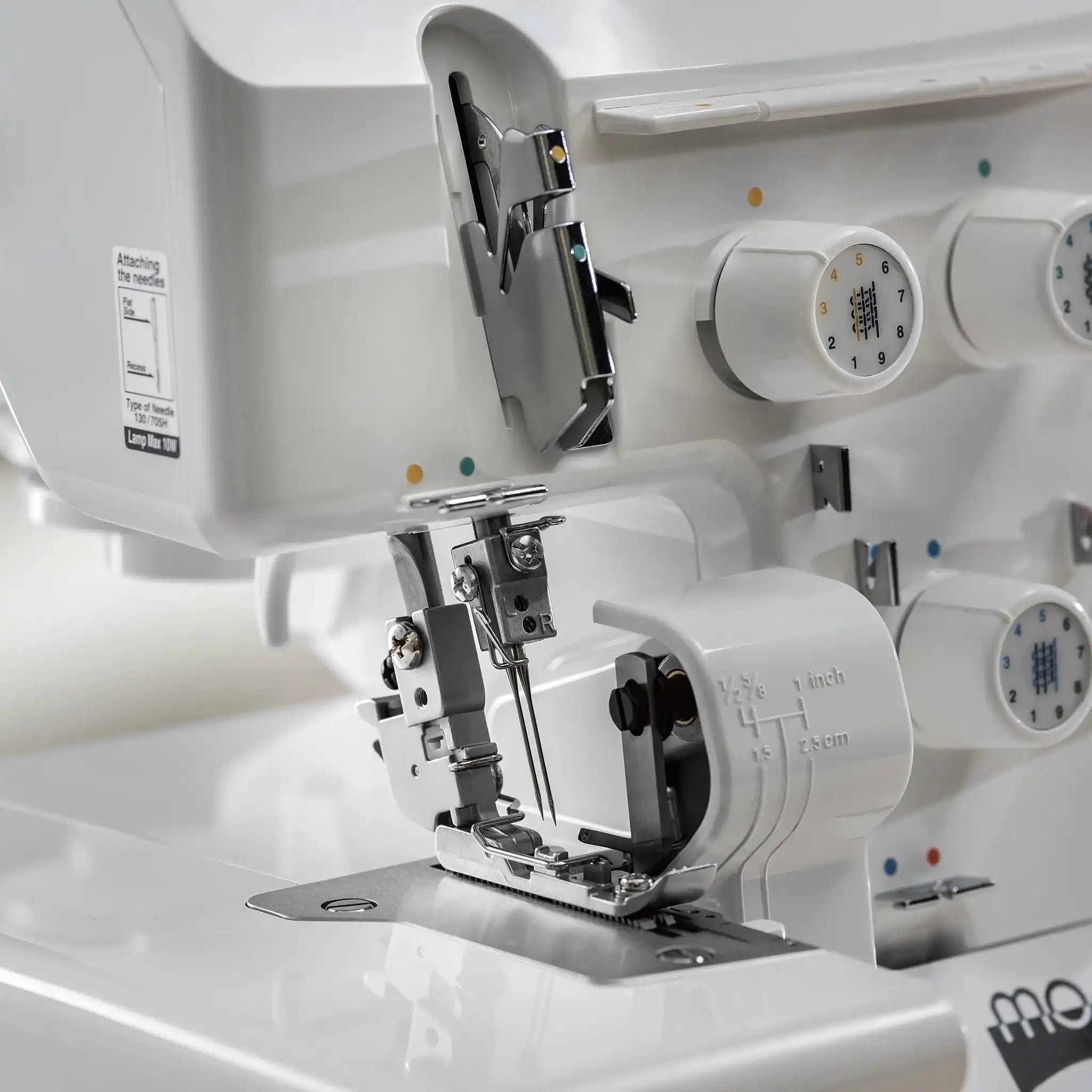
Tension adjustment is the first thing to check when wondering why my serger threads break. Too high tension pulls excessively on the thread, causing a clean, often sudden break.
On a serger, each thread has its own tension; a single incorrect setting can cause repeated serger thread breakage.
How to recognize thread tension that is too high?
- Thread breaks right from the start
- Very tight and stiff stitches
- Dry noise or clicking during sewing
- Strong resistance when pulling the thread by hand
For more details, manufacturers explain the recommended settings in their official guides, especially at Juki.
Incorrect threading: a common mistake on sergers
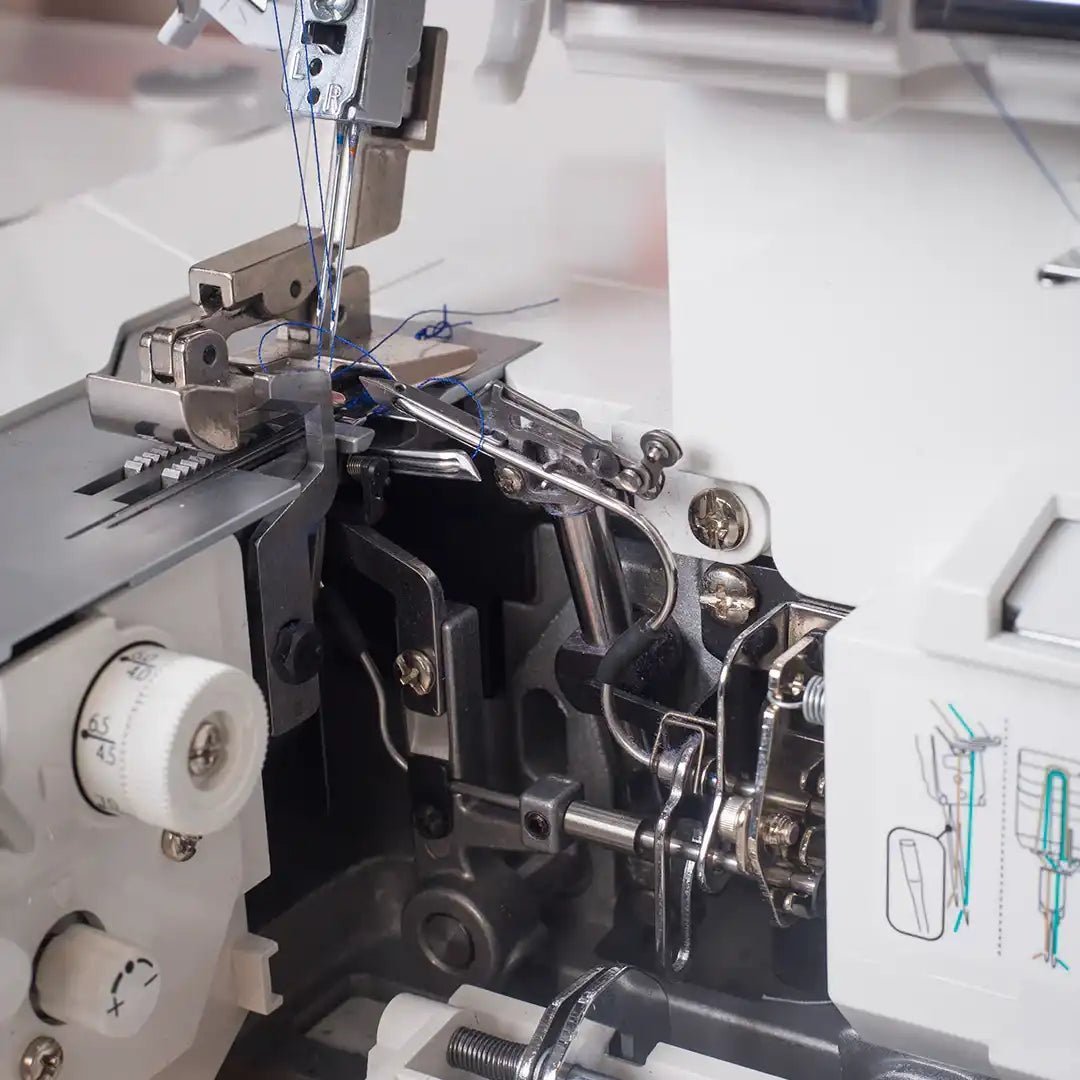
Incorrect threading is another major cause explaining why my serger threads break. Unlike a sewing machine, the serger requires a very precise threading order, especially for the loopers.
A poorly positioned thread may look fine visually but break as soon as the machine runs at full speed.
Why does incorrect threading cause threads to break?
- Threading order not followed
- Thread poorly placed in the tension discs
- Looper partially or incorrectly threaded
To check your threading, rely on an official tutorial or manufacturer’s guide, like those offered by Juki, Bernina, Janome, or Pfaff.
Thread quality and compatibility with the serger
When looking for why my serger threads break, the choice of thread is central. Fineness does not determine quality: what matters is the thread’s suitability for the speed, tension, and specific use of a serger.
A serger thread that breaks is often a thread not designed for this type of machine.
Which types of threads break most often?
Some threads are more fragile on a serger, even if they look fine at first glance.
- Old or dry threads that have become brittle over time
- Unsuitable decorative threads (metallic, shiny, textured) without specific adjustments
- Threads unsuitable for the speed and tension of a serger, even if they are of good quality
Summary table: thread and risk of breakage
| Thread type | Recommended use | Risk of breakage |
|---|---|---|
| Special polyester for serger | Regular sewing | Low |
| Old or poorly stored thread | To avoid | High |
| Decorative thread | Occasional use with adjustment | Medium |
To explore the topic further, manufacturers like Gütermann or Amann Group (Serafil) explain the differences between threads and their recommended uses.
Maintenance and actions that cause thread breakage
Even with good thread and correct settings, some habits still explain why the threads of my serger break. The serger is designed to feed the fabric on its own; any extra strain directly affects the thread.
Good serger maintenance is essential to maintain stable tension.
Handling mistakes to absolutely avoid
- Pulling or pushing the fabric while sewing
- Sewing too fast over thick layers
- Neglecting regular cleaning of the loopers
Bonus on why the threads of my serger break?
Prevention remains the best solution. A few simple checks before starting help avoid most cases of serger thread breaking without apparent reason.
Quick checklist before sewing
- Check the complete threading
- Test tension on a scrap
- Clean the machine
- Adjust speed to the fabric
Conclusion
If you were wondering why the threads of my serger break, you now know that the cause almost always lies in incorrect tension settings, improper threading, unsuitable thread, or lack of maintenance. By methodically correcting these points, it is entirely possible to sew for a long time without breakage.
A well-adjusted, properly threaded, and maintained serger provides smooth, consistent, and reliable stitching, even on demanding fabrics.
FAQ on why the threads of my serger break?
Why does the thread break as soon as I start sewing?
This usually indicates too high tension or incorrect threading.
Can poor-quality thread damage the serger?
Yes, repeated breakages can damage the loopers and misalign the machine.
Should all threads be changed when only one breaks?
No, but it is recommended to check the entire threading and tension settings.
Does thread breakage depend on the fabric used?
Yes, some fabrics require specific adjustments to tension and speed.

Leave a comment
This site is protected by hCaptcha and the hCaptcha Privacy Policy and Terms of Service apply.