







Table of Contents:
Seams that slip and zippers that shift are among the worst nightmares for sewing machine users. If you think the presser foot is just a simple accessory, you are far from the truth.
Indeed, it is the professional secret to successful projects. To avoid mistakes and improve precision, it is essential to know the different types of presser feet available on the market. Here, we will first explain the importance of a presser foot before revealing how to choose between a standard, blind-hem, or Teflon model to tame delicate and technical fabrics like a pro.
The presser foot: your indispensable ally on a sewing machine
Whether you are a beginner or an experienced sewer, the presser foot is an essential part of your sewing machine. Too often underestimated, it nevertheless plays a key role in the quality and precision of your seams.
Depending on the fabric, stitch, or desired finish, there is a wide variety of presser feet suited to every need. Choosing the right one means ensuring professional results and enjoying greater sewing comfort.
A key element for flawless seams
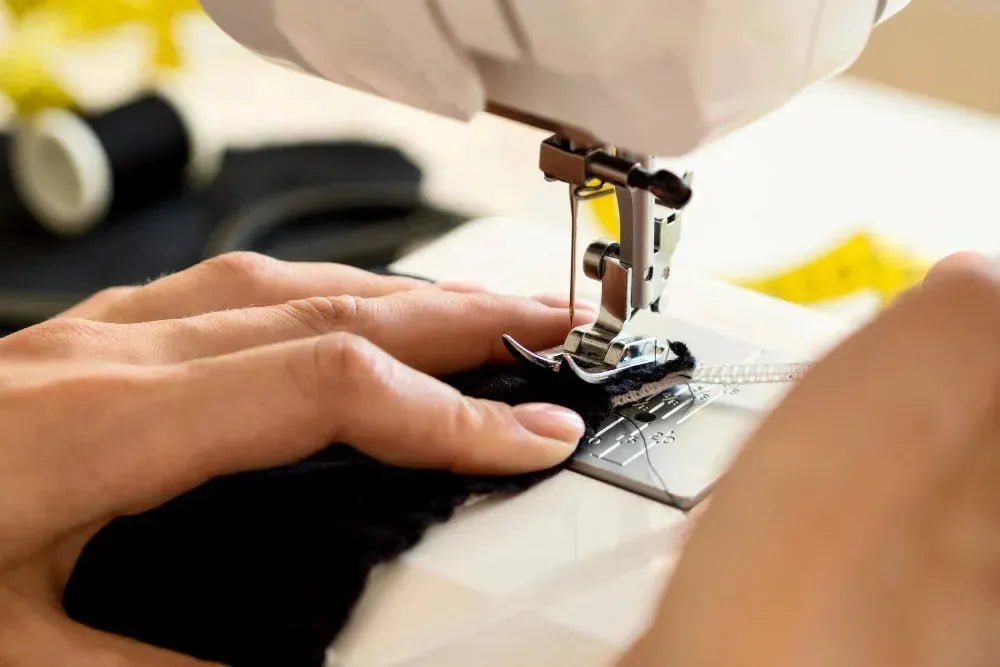
This small accessory clipped under your sewing machine conducts the orchestra during your sewing projects. It holds the fabric firmly against the feed dogs, ensuring even stitches and flawless hems. If you use a sewing machine for thick fabrics, choosing the right presser foot becomes even more crucial to prevent jams and achieve smooth sewing.
Here are 5 key situations where this small accessory becomes your best sewing companion:
- Tame challenging fabrics, thick leather or slippery silk, with a Teflon or roller foot for perfect feeding
- Install invisible zippers like a pro with the built-in guide of the specialized foot
- Create precisely measured hems in the blink of an eye with the adjustable hemming foot
- Create flawless buttonholes stress-free with the automatic foot that compensates for variations
- Master bias finishes with the piping foot for perfectly smooth curves
The pressure exerted by the presser foot is important. If it is too strong, it crushes delicate materials, and if it is too weak, it allows the fabric to slip. An optimal setting lets you adjust the tension to different types of textiles, from delicate mousselines to thick jeans.

Choosing among the different types of presser feet
It is precisely with these variations in fabrics and techniques that the different types of presser feet reveal their full value. Each one is designed for a very specific task, making your projects much easier and improving the final result.
Between the standard model for everyday work and specialized versions, the choice depends on your projects. The former is suitable for basic straight stitches and zigzags, while specialized feet greatly expand your creative possibilities.
To sew well in any situation, it is essential to understand the different types of presser feet and their uses. You will be pleased to find different models and types of presser feet in our online store.
Check compatibility: not all feet fit all machines. Always check the attachment system (clip or screw) and consult your machine's manual before purchasing. Brands such as Juki and Janome offer specific ranges.
By learning about the different types of presser feet, you will avoid mistakes and optimize your creations from the outset.
Standard foot
The standard presser foot is the Swiss army knife of your sewing machine. This small, versatile accessory handles straight stitches, zigzags, and even some basic buttonholes. Its secret is uniform pressure that holds the fabric against the feed dogs for perfectly smooth movement. Whether you are working with cotton, linen, or jersey, it adapts to almost all everyday textiles without hesitation.
But to get the most out of your sewing projects, it is useful to know the different types of presser feet. Each model has its specialty: some are designed for stretch fabrics, while others are made for ultra-precise finishes or challenging fabrics such as leather.
Among the favorites of experienced dressmakers, the JUKI presser foot stands out for its durability and precision, particularly on machines from the same brand, known for their performance.
To optimize its use, adjust your machine's pressure dial. If you are working with thick denim, simply increase the pressure. On the other hand, if you are working with delicate silk, reduce it. Also remember to adjust the stitch length for technical fabrics.
Pro tip: slide a piece of parchment paper under the foot when working with sticky materials such as faux leather. Above all, do not hesitate to switch between the different types of presser feet according to your needs: it is the best way to improve precision and sewing comfort.

Zipper
The zipper foot, like the narrow Juki zipper foot, turns a tricky task into child's play. Its side notches guide the needle to within a millimeter along the metal teeth.
You no longer need to struggle with the fabric. All you have to do is position the zipper against the guide and let the machine do its work. To avoid stubborn jams, choose a reinforced needle and clean the feed mechanism regularly.
This type of accessory is one of the different types of presser feet that truly make a difference depending on the technique used. Compared with the manual method, this specialized foot cuts installation time by two-thirds. The precision gained is well worth it, since there are no more uneven zigzag stitches or zippers that get stuck.
To get the most out of your sewing projects, make sure you are properly equipped for your specific needs: the different types of presser feet offer a solution adapted to every situation, whether you are inserting a zipper, sewing bias tape, or creating a perfect buttonhole. Test it on an old skirt before tackling your favorite leather jacket. The difference is obvious from the very first attempt.
Buttonhole
The automatic buttonhole foot is the secret ally for impeccable shirts. With this accessory, you no longer need to measure to the nearest millimeter. Simply place the button on the built-in guide, and the machine calculates the ideal size itself. Adjustments are effortless with the width dial, which adjusts the zigzag stitches in the blink of an eye.
This foot is one of the different types of presser feet designed to make technical tasks easier and improve precision. In sewing, every detail matters, and having the right accessory can make all the difference.
And if you regularly work with thick materials such as denim or velvet, also consider which sewing machine to choose for thick fabrics, as good compatibility between the machine and accessories ensures optimal results.
Still, watch out for common pitfalls. Thread tension that is too loose can distort the opening, while incorrect fabric alignment can result in crooked buttonholes. To avoid unpleasant surprises, always test on a scrap of fabric before starting.
One last tip: use a new needle for every project for clean, precise stitching.
Mastering the different types of presser feet will not only help you improve your finishes, but also sew more smoothly and confidently, whatever the project.
Roller
The roller foot becomes your best ally when working with thick leather or rigid denim. Its small metal rollers make the fabric glide effortlessly, even over the most stubborn surfaces. Choose a diamond-point needle that pierces without tearing, and remember to adjust the thread tension to prevent stitches that are too tight.
This clever little accessory impresses with its versatility. Try it on shiny patent leather or coated technical fabrics. The non-stick sole glides over even the most slippery materials without leaving marks. For special fabrics, remember to test it on a scrap piece before starting your main project.

Blind hem
To master the art of the discreet hem, follow these key steps:
- Prepare your fabric by folding the edge twice and carefully pressing each fold
- Install the blind hem foot by selecting the specific zigzag stitch for your machine
- Align the fabric fold against the foot's built-in guide so that the needle just skims the fabric
- Set the tension between 4 and 5 so that the stitches remain discreet on the right side
- Finish by removing the basting threads and lightly pressing the seam
With this method, your hems will remain invisible even on the finest fabrics such as silk or crepe. It's a must for evening dresses and elegant blouses. Try models such as the Juki zigzag hemming presser foot.
Walking foot
Technical comparison vs. standard foot | ||
Feature |
Standard foot |
Walking foot |
Supported thicknesses |
Up to 3 layers |
6 layers and more |
Stitch types |
Straight, zigzag |
Complex decorative stitches |
Difficult materials |
Limitations |
Leather, thick denim, quilted fabric |
Precision |
Standard |
Perfect alignment of multiple layers |
This table clearly shows the advantage of the walking foot for ambitious projects. This type of presser foot is ideal for assembling quilted jackets or working with thick leather. It quickly becomes indispensable as soon as you move beyond basic sewing.
Comparison
Choosing your presser foot is like assembling your toolbox: you start with the essentials before specializing. For beginners, it's best to rely on the winning trio of standard/zipper/buttonhole feet. For experts, it's preferable to combine a blind hem foot and a walking foot for ambitious projects.
You are now equipped to choose the ideal presser foot for your projects. Between the versatility of the standard model, the precision of specialized accessories, and tips for each fabric, your sewing machine can finally reveal its full potential. Experiment with these tools in your next creation, and every stitch will become child's play, transforming technical challenges into flawless results. Visit Verotex to find the presser foot suited to your needs and quality expectations.


Leave a comment
This site is protected by hCaptcha and the hCaptcha Privacy Policy and Terms of Service apply.