












 Thread matching your fabrics - LefilFrançais - 100 m
How to Make Jeans Without a Fly: Complete Tutorial
Sewing a pair of trousers is an excellent sewing project, allowing you to create a comfortable garment perfectly suited to your body shape. With a sewing pattern, you can create structured trousers with professional finishes.
The “Harmonie Trousers” pattern is designed to offer maximum comfort and adjustability, particularly thanks to its lacing system at the waist. It is ideal for a fabric such as stretch denim containing elastane, which provides flexibility and support.
In this guide, discover how to sew trousers step by step, following a genuine construction plan.
Video tutorial: how to sew jeans without a fly
Materials needed
Before you begin, prepare your materials.
You will need fabric (denim with elastane), strong thread, a needle suitable for thick fabrics, pins or clips, scissors, a tape measure, an iron, a trouser pattern, as well as eyelets and a ribbon for lacing.
Allow approximately:
- 1m60 (sizes 30 to 38)
- 2m20 (sizes 40 to 48)
- 2m60 (sizes 50 to 54)
Pattern measurement chart:
| Size | Waist measurement | Hip measurement |
|---|---|---|
| 30 | 58 cm | 82 cm |
| 32 | 62 cm | 86 cm |
| 34 | 66 cm | 90 cm |
| 36 | 70 cm | 94 cm |
| 38 | 74 cm | 98 cm |
| 40 | 78 cm | 102 cm |
| 42 | 82 cm | 106 cm |
| 44 | 86 cm | 110 cm |
| 46 | 90 cm | 114 cm |
| 48 | 94 cm | 118 cm |
| 50 | 100 cm | 123 cm |
| 52 | 106 cm | 128 cm |
| 54 | 112 cm | 133 cm |
Choose your size and prepare the pattern
For this model, base your choice mainly on your waist and hip measurements.
Then transfer the pattern pieces onto your fabric, following the grainline.
⚠️ The pattern does not include seam allowances:
- add 1 cm for the main seams
- add 4 cm for hems
Sewing steps:
Step 1: Sew the darts
Start by closing the trouser darts.
Fold the fabric right sides together following the markings, then sew the darts.
Step 2: Prepare the pocket
Fold the top of the pocket:
-
- 1 cm, then 2 cm, with an iron
Sew to form the pocket opening.
Step 3: Attach the pocket
Fold the other sides of the pocket, then position it on the trousers.
Sew with two lines of stitching for greater strength.
Step 4: Create the faux fly
Join the two front pieces right sides together at the rise.
Sew, then overlock the seam.
Step 5: Form the fly
Fold the fly flap to the left, then press the fold with an iron.
Step 6: Topstitch the fly
Topstitch the fly to hold its shape and achieve a neat finish.
Step 7: Assemble the back
Join the back rise, then overlock the seam.
Step 8: Prepare the finishing details
Overlock the underarm edges, facings and the other required pieces.
Step 9: Attach the waistband facing
Attach the front and back facings to the waistband of the trousers.
Sew, then topstitch to hold everything in place for a neat finish.
Step 10: Assemble the sides
Join the sides of the trousers up to the underlap.
Press the seams open.
Step 11: Assemble the crotch
Sew the crotch seam, making sure to align the seams properly.
Overlock, then press toward the back.
Step 12: Complete the underlap
Attach the underlap at the bottom of the trousers to complete the structure.
Step 13: Sew the hems
Fold up 2 cm, then another 2 cm, at the bottom of the trousers, then sew.
Step 14: Create the lacing ribbon
Fold the edges of the ribbon, fold it back on itself, then sew along its entire length.
Step 15: Add the eyelets and lacing
Place the eyelets about 1.5 cm from the edge, 4 cm apart.
Then thread the ribbon through to create the lacing.
Conclusion
Sewing a pair of trousers is a comprehensive project that allows you to master many sewing techniques: darts, pockets, fly, construction and finishing.
The Harmonie pattern offers an excellent balance between comfort and style, thanks to its lacing system and stretch fabric.
With practice, you will be able to adapt this pattern and create unique trousers that fit your body shape perfectly.
FAQ - How to sew a pair of trousers
Is it a difficult project?
This is an intermediate-level project.
Which fabric should you choose?
Stretch denim is ideal.
Do you need an overlocker?
No, but it improves the finish.
Why add seam allowances?
Because they are not included in the pattern.
How long does it take?
About one day, depending on your skill level.
The haberdashery you need
Prices and stock come from the catalog and update automatically. Each button takes you to the product page, where you can choose the quantity.
Thread matching your fabrics - LefilFrançais - 100 m
 Schmetz jeans needle 90 to 110
 White Elastic 25 mm
2,00 €
/meter
Sold out, view the product page
White Elastic 25 mm
Free delivery on fabric and haberdashery orders over €75.
VX
VX
The movements this project requires
Each step has its own guide, detailed step by step. Open the one you're stuck on, then return to the assembly.


Learn to use it at the workshop
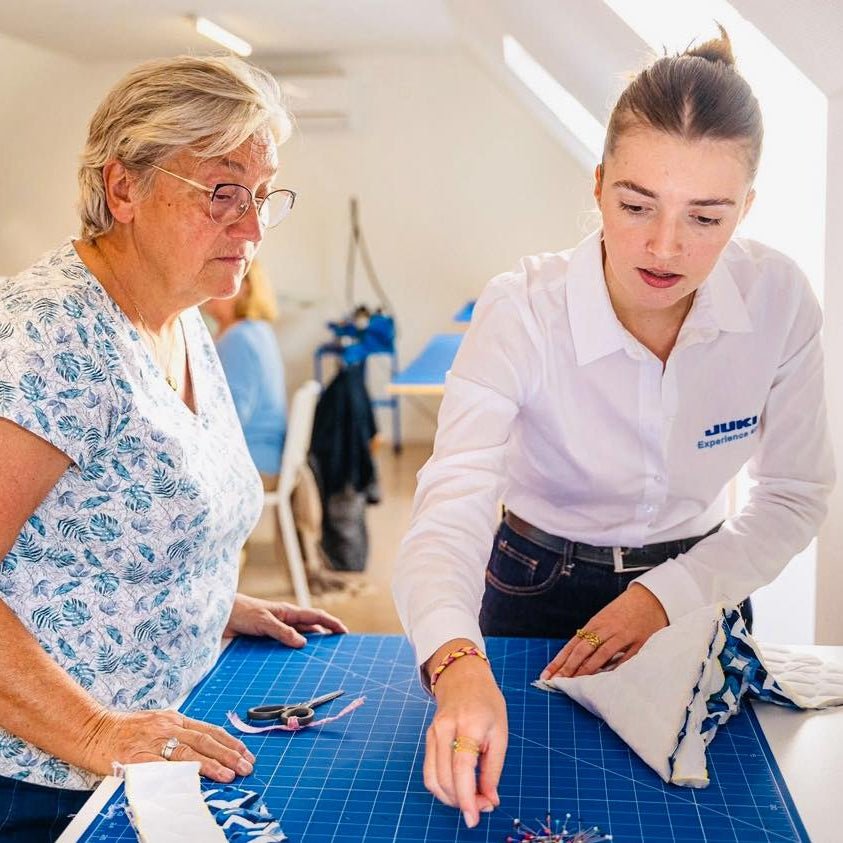
We assemble the pattern with you, using your machine and your fabric. Prices can be discussed on-site or by phone.

Open Project Workshops: Create at Your Own Pace – For Beginners
1 Flexible hours
Some places
View this course

Open Project Workshops at the Store with Moondust Workshop
3 Flexible hours
Some places
View this course


Stuck during assembly?
Send us a photo of your project on WhatsApp. Our experts can recognize most mistakes at a glance and tell you what to redo.
- Same-day response, Tuesday to Saturday
- We’ll show it to you in person at the workshop
- No question is silly; we all started somewhere
What difference does sewing this project with us make?
Fabric cut to your required lengthWe cut to order by the metre, and our fabrics are pre-washed.
The assembled model in front of youThe workshop is open Tuesday through Saturday, from 10 a.m. to 6 p.m.
Haberdashery all in one placeThread, zipper, elastic, and bias binding are shipped in the same package as the fabric piece.