

















Table of Contents:
Darts are an essential sewing technique that allows you to shape volume and to adjust a garment to the body's curves. Whether for a shaped bust, a defined waist, hips, or shoulders, they provide a harmonious shape and a perfect drape .
In this article, we will discover how to make a simple and double dart, step by step, for a professional finish.
What is a dart in sewing?
Darts are sewn folds in the shape of a triangle, whose base corresponds to the amount of fabric removed to create volume, while the tip tapers gradually to blend into the fabric.
The simple dart step by step:
Mark the reference points

The first step is to transfer onto the fabric the pattern marks using a fabric pencil or chalk. You need to mark:
- Points A and A' located at the base of the dart.
- Point B representing the tip where the seam tapers off gradually.
Tip: Use special sewing carbon paper to transfer the marks precisely onto the fabric.
Mark the dart for perfect alignment
To avoid any shifting during sewing, it is essential to mark the dart well:
- For thin and slippery fabrics, draw the dependent lines A and A' to B directly on fabric laid flat.
- For other fabrics, fold the fabric right sides together by matching points A, A', and B .
Tip: Check that the dart forms a well-balanced triangle before pinning!
Mark the fold and ensure proper alignment


Before sewing, mark slightly the fold with the help of an iron. This step helps to hold the dart in place and makes assembly easier.
- Use a tailor's chalk or a washable pencil to reinforce the line.
- Check that the fold passes perfectly at point B .
Why is this step important? A well-defined fold prevents mistakes and ensures a precise result !
Pin the dart correctly

Once the dart is well marked, you need to pin correctly to ensure good hold during sewing.
- Place the pins perpendicular on the line.
- Check that the drawn lines overlap perfectly .
- The pin must pierce exactly on the line on each side to prevent any shifting.
Tip: Pin carefully without pulling the fabric to avoid any distortion!
Sew the dart precisely

Now let's move on to sewing the dart!
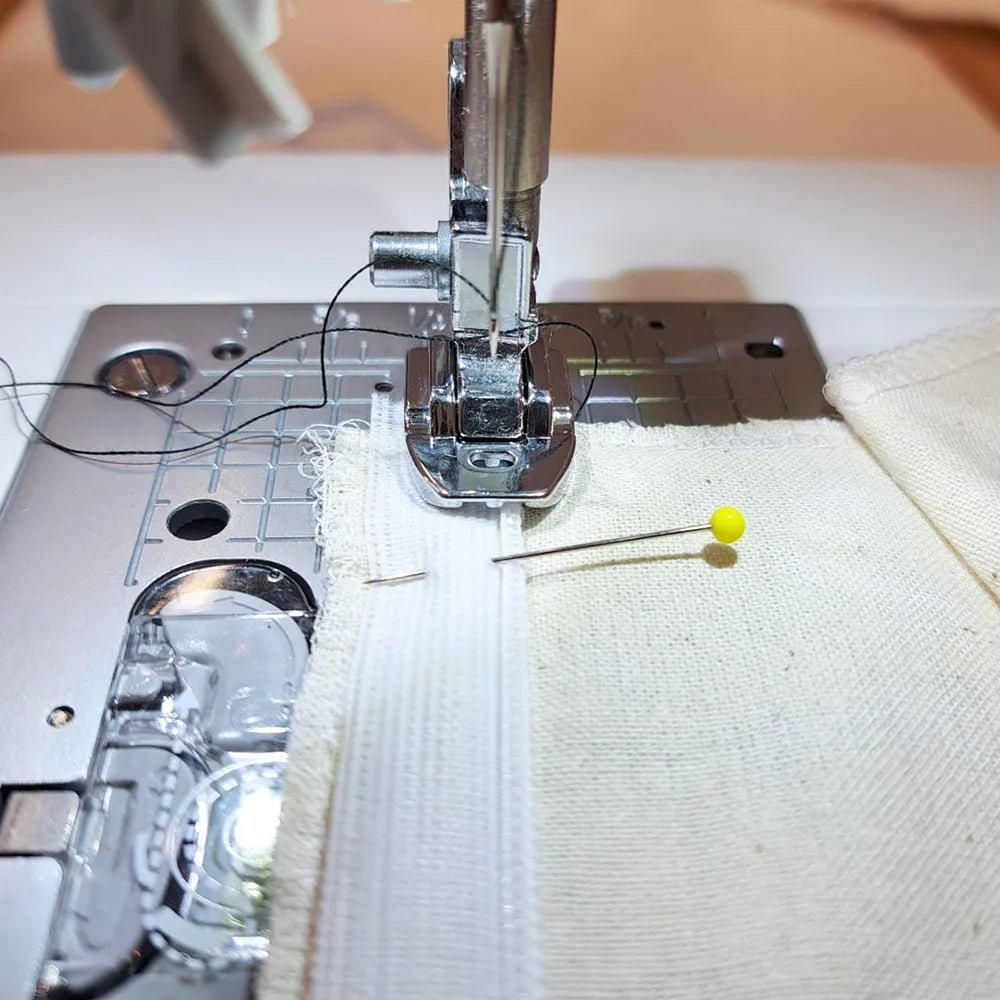
- Start with a backstitch at the base AA'.
- Sew in a straight line towards B with a straight stitch with a length of 2.5 .
- Follow the line precisely to prevent any shifting.
Finish the seam neatly

Approaching point B (about 2 cm before the end ), you need to shorten the stitch length for a softer finish:
- Switch from 2.5 to 1.5 at the end of the seam.
- Do not make a backstitch! Instead, leave the threads long, tie them by hand, and hide them in the seam.
Why not make a backstitch?
This prevents excess fabric that would create a beak effect at the dart tip.
How to get perfectly smooth darts in sewing?
Sew the last stitches for a discreet finish
The finish of a dart relies on a fine and precise seam. To avoid an unsightly bulk:
- Finish the seam by stitching parallel to the fold, just 1 mm from it.
- Do not make a backstitch at the end of the dart to avoid a too thick seam.
- Cut the threads leaving about 10 cm in length to be able to tie them neatly.
Tie the threads by hand for a clean finish

Once the sewing is finished:
- Tie the threads by hand rather than making a backstitch.
- Using a needle, slide the threads into the dart so they are invisible on the right side.
- Cut the threads close to the fabric to prevent them from sticking out.
Why is this step important? This ensures a clean finish and a neat dart tip without visible bulk .
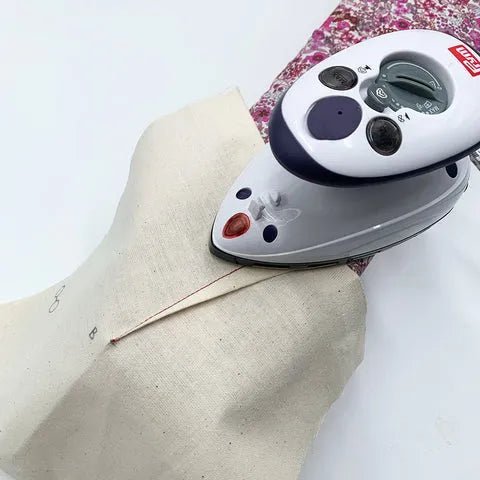
Properly iron the dart for a smooth drape

Ironing is a crucial step to set the dart and prevent it from being too noticeable.
- Open the fabric and iron on the wrong side.
- Use a tailor's ham or the edge of your ironing board to properly shape the dart and prevent excessive marking.
- Place the tip of the dart in the air to avoid crushing the fabric at that spot.
- Gently iron from the base to the tip B, without pressing too hard.
Tip: For perfect ironing, use a lukewarm iron and steam to soften the fabric fibers.
Tip for fabrics that mark too much
Some materials retain the marks of darts after ironing. Here's how to avoid them:
Check the appearance on the right side of the fabric

After ironing, check that the dart is well integrated and does not form a visible bulk .
- The dart must be discreet and smooth , without creating a pocket effect.
- If the fabric remains slightly marked, iron with an intermediate fabric to soften the iron's pressure.
To remember: The thicker the fabric, the more essential this step is to avoid too visible a relief.
Use a strip of cardboard to avoid marks
If the fabric marks too much after ironing:
- Slide a strip of cardboard between the fabric and the dart before ironing.
- It prevents the heat of the iron from crushing the dart too much and leaving a visible mark on the right side.
Why does this technique work?
Paper absorbs the pressure and protects the fabric fibers from excessive crushing.
How to open a dart in a thick fabric?
Thick fabrics, like wool or denim, can causes a problem of bulk if the dart is simply folded to one side. Here is an effective method to fix this.
Pressing the dart to avoid marks
- Rather than pressing the dart to one side, press it down in the middle using an iron.
- It allows flattening the thickness and distributing the fabric evenly.
Why is this method useful?
It allows you to achieve a flat and smooth dart, ideal for coats and very thick fabrics.
How to sew a double dart in sewing?
What is a double dart?
A double dart consists of two opposing triangles, forming a diamond shape at its base. It follows the same principle as a simple dart but with two symmetrical seams, creating a more defined shape and better-distributed volume.
Where where do we find double darts?
- On the front or back of a mixed fabric dress.
- At the waist of fitted blouses and jackets.
- On some pants and skirts for a structured effect.
Here are the different steps to follow for a flawless finish
Mark the reference points

As with a simple dart, you must first transfer the pattern markings on the wrong side of the fabric:
- Point B to identify the high tip of the dart.
- Points A and A' located in the middle, represent the depth.
- Point C marking the lower end of the dart.
Tip: For better accuracy, use a washable fabric pen or a tracing wheel .
Mark and pin the dart

Once the marks are drawn, you need to pinch the fabric right sides together making sure that to ensure points A and A' are perfectly aligned .
- Use a pin to stabilize the fabric layers.
- Draw a line based on the points , as with a single dart.
Why is this step essential? Poor alignment can distort the garment during assembly.
Mark the fold between B and C


To ensure better hold before sewing:
- Press the fold lightly between B and C to clearly mark the sewing line.
- For thin and slippery fabrics, it is recommended to mark the dart on the fabric laid flat before sewing the dart.
Make the first seam

The double dart is sewn in two stages :
- Start sewing from A/A' towards B or C.
- Make a backstitch at the start to secure the seam.
- Finish without a backstitch at the point to avoid bulk.
Make the second seam

Once the first seam is finished:
- Sew the second part of the dart , identical to the first.
- Maintain alignment for perfect symmetry.
As with the previous dart, make a double hand knot to get a flat dart at its top.

Conclusion:
Darts are a a key element in sewing, allowing you to shape a garment to the body and ensure a smooth, structured drape. Whether you are making a single dart, a double dart, or working with thin or thick fabric, precision and finishing are essential to ensure a neat and professional result.
Key points for successful darts:
- Mark the reference points precisely and check alignment before sewing.
- Pin carefully to prevent any shifting.
- Sew with appropriate tension and without a backstitch at the end.
- Slip the threads into the dart for a clean and invisible finish.
- Press carefully to avoid marks and gently secure the dart.
- For thick fabrics , open or release the dart to avoid bulk.
By applying these tips, your darts will be clean, well-fitted, and perfectly integrated into the garment !
And you, what are your tips for flawless darts? Share your experiences in the comments!

Leave a comment
This site is protected by hCaptcha and the hCaptcha Privacy Policy and Terms of Service apply.