















Table of Contents:
Pockets in sewing are essential elements, both practical and aesthetic. Whether you are working with a sewing machine or by hand, they add style while being useful in everyday life.
Depending on the garment or accessory being made (trousers, jacket, bag), the type of pocket will not be the same. Each model has its own specific features and requires a particular sewing technique.
Depending on the fabric used (cotton, jeans, linen, thick fabric), the appearance and structure of the pocket may also vary.
In this guide, discover the different types of pockets and learn how to choose the one that best suits your sewing project.
What you need to know before sewing a pocket
Before sewing a pocket, it is important to understand its purpose.
A pocket can be decorative, functional or both at the same time. It must be suited to the garment, the fabric and its intended use.
Some pockets are visible and add style, while others are invisible and integrated directly into the seams for a more discreet finish.
The different types of pockets in sewing
There are several types of pockets in sewing, each with its own characteristics. Knowing them well makes it possible to choose the right technique and achieve a result suited to your project.
The patch pocket

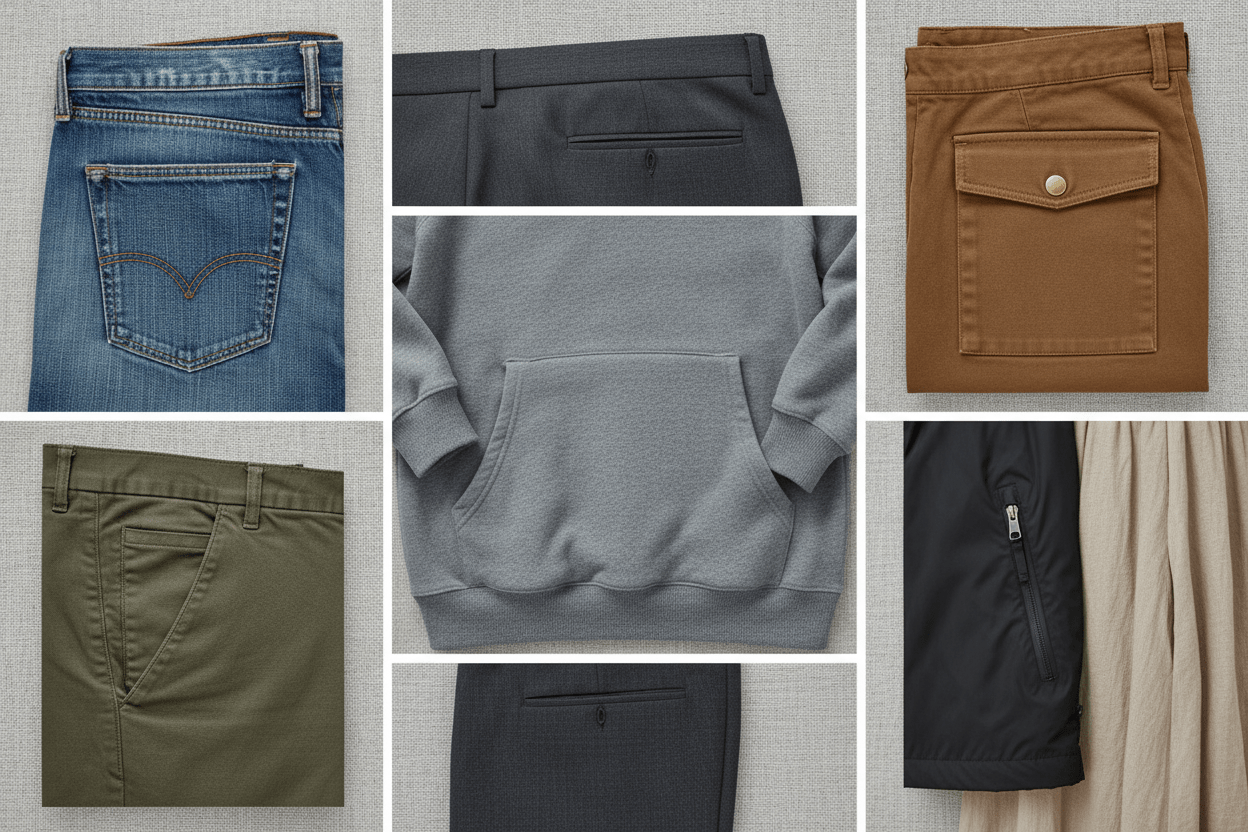
The patch pocket is one of the simplest to make. It is sewn directly onto the outside of the garment.
It is highly visible and can become a decorative element. It is often found on jeans, shirts, jackets or aprons.
It is an excellent option for beginners in sewing, as it does not require complex techniques.
The in-seam pocket (invisible pocket)
The in-seam pocket (or invisible pocket) is integrated directly into a seam of the garment, usually at the sides.
The pocket bags are sewn into the seam, allowing them to be completely concealed. Once the garment is finished, the pocket is almost invisible.
It is widely used on dresses, skirts, and trousers for a discreet, clean look.
Italian pocket

The Italian pocket is an angled pocket, often used on elegant trousers.
It is both discreet and easy to access, while providing a neat, professional finish.
Jeans pocket

The jeans pocket is very similar to the Italian pocket in its construction, but it stands out through its rounded shape and more casual style.
It is mainly found on jeans, where it is often paired with a small additional pocket (coin pocket).
It is sturdy and suitable for thick fabrics such as denim.
Welt pocket

The welt pocket is made by creating an opening directly in the garment fabric, cutting and notching the fabric precisely before inserting the welts and pocket bag.
It is discreet and almost invisible once the garment is finished, making it a highly appreciated elegant finish.
It is mainly found on elegant jackets and trousers, where it adds a refined and structured touch.
The welt pocket is one of the most complex sewing techniques. It requires precision and skill, making it suitable for experienced dressmakers.
Zippered pocket
The zippered pocket features a zipper to keep items secure.
It can be made in two ways:
- inserted into a seam (easier to sew)
- directly into a garment piece by cutting and notching the fabric
It is often found on bags, jackets, and technical garments.
Kangaroo pocket

The kangaroo pocket is a large pocket placed on the front of the garment.
It is often found on sweatshirts and hoodies. It is practical and comfortable, ideal for a casual style.
It is simple to make and highly functional.
The flap pocket

The flap pocket is a pocket covered by a piece of fabric called a flap.
It is both attractive and practical, as it protects the pocket's contents.
It is often found on jackets, coats and utility garments.
Mistakes to avoid when sewing a pocket
Sewing a pocket requires precision. Some mistakes can affect the final result.
It is important to position the pocket correctly before sewing it, to prevent it from being crooked.
You should also adapt the pocket size to the garment so that it remains proportionate.
Finally, remember to reinforce the attachment points, as these areas are subject to heavy use.
Which pocket should you choose for your sewing project?
Choosing the right pocket is essential to give your creations both style and functionality.
At Verotex, we offer fabrics for sewing suitable for all your projects:
easy-to-work-with cotton, durable denim, or even soft fabrics for discreet finishes.
Whether you are making a patch pocket, an invisible pocket or a zippered pocket, choosing the right fabric helps achieve a neat and professional result.
Conclusion
Sewing pockets are essential elements. They provide style, practicality and a professional finish.
Each type of pocket has its own features and is suited to a specific use. By choosing the right technique, you can improve the quality of your creations.
With practice, you will be able to easily master these different techniques and enhance your sewing projects.
FAQ: Types of Sewing Pockets
Which pocket is the easiest to make?
The patch pocket is ideal for beginners.
Which pocket is the most discreet?
The seam pocket is the most discreet.
Which pocket is best for a sweatshirt?
The kangaroo pocket is the most suitable.
Can a pocket be added after sewing?
Yes, especially a patch pocket.
Which pocket is best for keeping your belongings secure?
The zippered pocket is the most secure.


Leave a comment
This site is protected by hCaptcha and the hCaptcha Privacy Policy and Terms of Service apply.